Friday, October 22, 2010

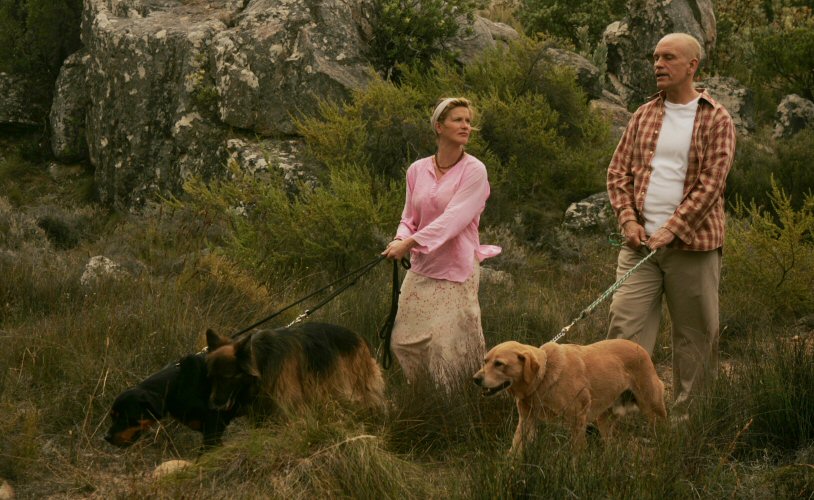
Film Review #237: Never Let Me Go
2010
Director: Mark Romanek
Cast: Carrie Mulligan, Keira Knightly, Andrew Garfield

Having enthusiastically lent my own copy of Kasuo Ishiguro’s 2005 novel Never Let Me Go to a friend after finishing it, I don’t have it here to check the exact page where the Japanese-born British writer actually uses the word “clones” for the first time. I did circle the word when I came upon it, and I’m betting it’s within the last 25 pages out of just over 300. As novels go, this is something of a triumph, because of course you “know” well before that moment, but not having seen the word itself for so much of the story creates a kind of tension.

The last time I recall reading a novel that I so could not put down, it was Caleb Carr’s historical murder and detective mystery The Alienist. That was in 1994. I read The Alienist all the way to Vancouver on a plane and was, I’m afraid, fairly anti-social for the first day or so between sessions of the conference I was attending until I finished it. As NPR and Washington Post book reviewer Maureen Corrigan reminds us, such novels are really about thinking – about how we know what we think we know – and The Alienist combines a cracking good serial murder yarn, set vividly in New York City at one of its most fascinating moments, with the very roots and early invention of detective work.

But Ishiguro’s novel, which has a huge following of fierce partisans – among them the remarkable English actress Carrie Mulligan, who plays Kathy H., the narrator, and has said she “could not bear” to think of anyone else getting the part – is not really about thinking, except on the surface as something to occupy us and the characters alike, even though there are a number if plot lines that seem to be about finding something out. In fact the 28-year-old Kathy H. is clearly not honest and searching with herself much of the time.

Instead, it’s really a story about being. As such, given its meditative style, it’s extremely hard to consider adapting this novel for the screen. Though it’s been called “sci-fi” that label seems odd somehow, because it completely lacks the action-blockbuster arc of its cousins in most contemporary re-tellings of the Pinocchio tale. Such close relatives would be films with characters like Wesley Snipes in the Blade movies, or Sigourney Weaver’s Ripley who takes that ontologically tantalizing swerve in the last installment of the Alien films, for example. But even on a grand scale, movies about being that are not made in the action-blockbuster mold have a hard time connecting – witness Spielberg’s criminally under-rated A.I., Artificial Intelligence.

Mark Romanek’s screen version, which released in mid-September, has been eagerly anticipated because the novel itself is so well-regarded, but also because this film has some of the best casting in memory. If you’re old enough to remember the 1982 screen version of John Irving’s 1978 novel, The World According to Garp, you’ll recall it was inconceivable that anyone but Robin Williams could play Garp. Just so here: no one but Mulligan could play Kathy H., Keira Knightly is brilliant as Ruth, and Andrew Garfield – plastered all over American multiplexes in The Social Connection, but first coming to my attention last year in Red Riding Trilogy – embodies Tommy. Moreover, I’ve never seen such good casting of younger versions of movie characters. Isabel Meikle-Small as young Kathy looks like Mulligan – and has her facial expressions and movements down cold. Ella Purnell is immediately recognizable as the child who becomes Keira Knightly’s Ruth. And Charlie Rowe makes Tommy actually clearer than he is in the novel – just as Sally Hawkins does for Miss Lucy, the teacher who abruptly fired for explaining to the students at Hailsham what their lives will be and what they are for.

Hailsham is a secluded boarding school in the British countryside where, in the 1970s, we meet Kathy, Ruth and Tommy in what I presume to be the fifth or sixth grade. Charlotte Rampling is headmistress Miss Emily, presiding over the school’s regimen of keeping the children in serene isolation and optimally healthy while engaging them in an education that emphasizes the arts and sports. The arts, as they figure out years later, somehow comprise “verifiable proof” of their true natures. Kathy and Tommy decide that artistic production might be evidence they can truly love – they track down Miss Emily to seek deferrals of their own “donations” of body parts – whereas Miss Emily refines that stab in the dark to mean more precisely that they have souls. A teacher of mine once talked as hauntingly about the ancient cave paintings at Lescaux in this way: that at the moment those prehistoric cave dwellers picked up their charcoal and made images, they became human.

Word of mouth and a great deal of buzz have surely informed you that this is a love triangle of sorts: first it’s Tommy and the not-very-admirable Ruth, and then Kathy and Tommy, with the soon-deceased Ruth’s blessing. This occurs over three chapters roughly each a decade apart, in school, leaving the school to be stashed in some backwater cottages and imagine finding their “originals,” separate and some years later reunite briefly as one by one they “complete.” It is Kathy who’s left in the end, gazing into a field on a scrubby back road, her last voice-over an additional piece of dialogue not in the novel, in which she wonders – somewhat jarringly and redundantly, the very opposite of what Ishiguro accomplishes by withholding the word “clone” for so long – if she and the rest of us are not so different after all.

These performances are just superb and I will likely see this movie again. But the film has some flaws that explain complaints that it “fails to connect” and arise, ironically, from some effort to make this more “cinematic.” First, there is Rachel Portman’s overbearing and melodramatic score, so intrusive that it becomes distracting. We do not need a note of it, much less the Douglas Sirk-like deluge we get, to feel anguish in the presence of this story and these performances. Second, so much is pared away from the novel in order to emerge with a lean and action-laden, a less “interior,” plot, that I’m left wondering – as I wondered after “Garp” – whether I would like the movie if I had not read the book. That is, perfect casting or not, would the film be as rich, as emotionally intelligible, without already knowing the novel?

That is too late for me to answer. Ishiguro himself doesn’t mind. In fact, he’s long met regularly with his neighbor, Alex Garland, who wrote the screenplay, to talk over their work, and besides serving as the film’s executive producer, pronounced himself pleased with the script.

So Never Let Me Go is, I suppose, a murder mystery after all.

*******
A shorter version of this review appears in the October 21, 2010 print edition of The Eagle weekly. “Never Let Me Go” screens for the second week at Manlius Art Cinema.
SYRFILM Round-up: 7th Annual Syracuse International Film Festival

First, the Winners!

Last week I told you in my column "Make it Snappy" that Marek Najbrt's film Protektor (also the Czech official Oscar entry) was the best film in the festival. And on Sunday night, the SYRFILM judges agreed. Protektor took Best Fiction Feature Film, Best Actress (Jana Plodkova), Best Editor, Best Music, Best Screenplay. Syracuse native Mary Angiolillo, who now lives in Prague and teaches at the national film school there, FAMU, sent Protektor to SYRFILM.

Other award recipients were:
Best Experimental Film: Homewrecka by Joey Huertas (USA). Huertas has had a film entered in SYRFILM each of the festival’s seven years, and this documentary about domestic violence was the third win for him in this category.
Best Animation: Ariadne’s Thread by Bertóti Attila (Romania).
Special Judges Citation in Animation: Chameleon by Anna Rettberg (USA).
Best Central New York Film: Thicker Than Water by Bradley Rappa (USA), documentary.
Best Short Documentary: One Day Will be Once by Anca Miruna Lazarescu (Germany).
Director’s Special Citation for Short Documentary: Kayatsum by Grigor Harutyunyan (Armenia).
Best Short Fiction: Rosenhill by Johan Lundborg and Johan Storm (Sweden).
Special Judges’ Citation for Short Fiction: Pile-Up/Koccanás by Ferenc Török (Hungary).
Director’s Special Citation for Short Fiction: Requiem for Kosovo by Dhimiter Ismailaj (Albania).
Best Feature Documentary was awarded to two films: Long Distance by Amikam Goldberg (Israel) and The Two Escobars by Jeff Zimbalist and Michael Zimbalist (Colombia/USA).
Judges’ Special Citation for Artistic Achievement in Feature Documentary: Queen of the Sun by Taggart Siegel (USA).
Best Cinematography in a Narrative Feature: Larry Smith for Bronson (UK) Best Actor: Tom Hardy in Bronson
Best Director: Nicholas Wending Refn for Bronson
Judges’ Special Citations: Sand by Rob Nilsson (USA) and To Catch a Billionaire by Tomas Vorel (Czech Republic).
Director’s Special Citations: Pizza with Bullets by Robert Rothbard (USA) and Touching Home by Logan and Noah Miller (USA).

SYRFILM occupied a new spot on the calendar this year, moving from late April to mid-October. Students, who have usually been scarce at a festival that ran during final exam week, were much more in evidence this year. SYRFILM also shortened its run to four and a half days, down from the previous gargantuan nine, and reduced local screening venues to four (The Palace in Eastwood, Redhouse Arts Center in Armory Square, Watson Theater on Syracuse University’s campus and Grewen Auditorium at LeMoyne College). But the festival also added four “satellite” venues in the out-lying communities of Hamilton, Rome, Geneva and Oswego. By Friday evening it was apparent that festival-goers liked this more relaxed schedule with fewer films, less rushing around the city and more chance to interact with one another. This year festival judges also escaped spending their days locked in a room watching one film after another until they were hollow-eyed; provided with screeners of the films in competition two months before the festival, they also relaxed, networked, and caught other films they usually wouldn’t have time for.

As one of those local arts organizations that saw its county budget totally cut the same week it opened for the seventh year, SYRFILM is used to reinventing itself and remains determined to make a go of it. Christine Fawcett Shapiro remains an integral part of the festival, but she’s retired as managing director and now focuses on outreach and development. Until the fate of managing director is determined – Syracuse University funds that position – KC Duggan has been interim managing director for this year’s fest. Duggan, a filmmaker herself who returned to Syracuse to do this job of nuts and bolts madness, is worth at least her weight in gold. If SYRFILM can’t find a way to keep her, she’ll be somebody else’s Genuine Find.

Both SYRFILM’s opening night (the screening of Pizza with Bullets and the presence of its star, Vincent Pastore, and director, Richard Rothbart) and closing night (besides the awards ceremony, the screening of two Ed Harris films, Touching Home and the still-lustrous Pollack, plus Harris himself) have had attention. Some of what happened in between – and whom – well, not so much. Here are just several thumbnails.

Javon Jackson Channels Alfred Hitchcock for The Lodger

Every year since its inception, SYRFILM has shown a classic silent film accompanied by a live jazz performance. While this has become increasingly popular nationwide in the last several years, it’s been a SYRFILM signature event that usually sells out. This year’s event was packed too, despite a freezing downpour and whipping, icy wind. But after all, such weather was appropriate to the 1927 tale of a serial murderer who preyed on young blondes in London’s foggy night streets. Lemoyne College and the Society for New Music co-sponsored this event, the latter finding some local musicians to fill in some of the seats for Los Angeles-based saxophonist Javon Jackson, who brought just the rhythm section – the drum, the bass and the piano players – of his octet.

Society for New Music also located local singer Bridget Moriarty, who got Jackson’s score a month before the screening and made do with a marathon rehearsal of four or five hours the day before. Jackson said after the performance that Moriarty “came in so meek and got behind the mic and turned into a maniac.”

That was Christine Fawcett Shapiro’s idea, the singing. As far as they know, the current crop of live jazz-silent classic screenings hasn’t included any choral component until now. Jackson, who calls her “my surrogate sister,” met Christine Fawcett Shapiro at the Eastman School of Music in Rochester during an event where he was a presenter. Both say they “immediately clicked.”

SYRFILM chose Hitchcock’s early thriller - the English master director director was in his 20s when he made it - as part of a focus on Hitchcock in collaboration with Syracuse Stage, which opens The 39 Steps this week, a comedy based on the Hitchcock film of the same name. The Lodger is available for instant streaming at Netflix, and that’s how Javon Jackson first watched it himself. He says it was a difficult commission.

“There are a lot of abrupt tempo changes in the score,” he said last Friday night after the screening and performance. “Unlike live performance, if we were recording, we’d just splice the pieces.”

Jackson said he started the score last February with a goal of finishing the score by July 15th and he made his deadline. “I’d go through and watch about ten minutes at a time and work on that. I went on two European tours while I was writing the score. The themes would just come as I watched and I actually saw a lot of humor in some parts. We’ve had a lot more diabolical characters since that time – Jason, for example. I wanted a balance between the music of Tin Pan Alley in the 1930s and 40s and jazz now. That great stride piano stuff at the end, that’s from the period of Tatum and Fats Waller.”

Jackson, who also talked with two Lemoyne classes during his visit here, will be back in Central New York on Tuesday, December 7th at SUNY Oswego, where he’ll do a musician’s clinic and a concert. His next tour takes him to New York City, Pittsburgh, points in California and Kansas City, and sometime in there a date in Albany at “the Egg” in the State Capital.

Haim Bouzaglou’s Session Premieres; Hotel Syracuse in the Works

On Friday eve the fest buzzed with more than Javon Jackson’s sizzling jazz performance. This year’s weird election doings even penetrated the fest; that day a State Assembly candidate’s mailer accused his opponent of enormous payoffs to the “special interests” of “Hollywood” while at the same time excessively taxing New Yorkers. This refers to tax incentives to attract film production to New York State, which has the second largest film and television industry in the nation. Most often such productions have very little to do with “Hollywood” studios but everything to do with indie productions and in the case of SYRFILM, a particular focus on attracting foreign filmmakers who wish to make their first American feature. SYRFILM has been at the forefront of efforts to attract such film productions upstate, where local talent and facilities and permit fees are all less expensive than those in New York City. Jerry Stoeffhaas of the Governor’s Office on Motion Picture and Television attended the entire conference. According to one recent study, in 2008 such productions paid $3.3 billion in wages directly to New Yorkers, before even mentioning other revenues generated by rents, purchases and use of New York-owned facilities. While such film production has long been centered in New York City, in recent years upstate cities and regions have actively developed packages to attract filmmakers. Visit www.nylovesfilm.com to learn more about upstate’s regional film offices.

Israeli filmmaker Haim Bouzaglou’s feature film Session, which premiered on Thursday night at the Palace Theatre, is one result of such efforts. With a score by Oscar-winning composer Jeff Beale – a result of the two meeting at last year’s festival – Bouzaglou’s film is now set to screen in Los Angeles, with a number of European festivals in the offing. Bouzaglou has been here before, both as a festival entrant and as a visiting professor at Syracuse University. Session, which he developed with SYRFILM’s Owen Shapiro, is part of a two-film project. The second film, Hotel Syracuse, has signed John Malkovich as the lead actor.

“We are aiming to shoot next summer at this point,” Bouzaglou told me Friday night. “While John’s schedule is hard to work around, he has also invested in this film and led me to others who support it.”

This includes the lead actress whom Bouzaglou said they would not reveal publicly until she had actually signed. Bouzaglou shoots his next film in France, which he says he’ll enjoy because, “I have a baby – well, four – and another child, and I can take them all with me to France.”

From Israeli Consulate to SYRFILM Judge

Herself from an Israeli family of filmmakers, Shani Hashnaviah‘s relationship with SYRFILM dates back several years. From early 2006 until late 2008 she worked with the Israeli Consulate in New York City as director of film promotion and outreach for the US and Canada. In this capacity she managed distribution of Israeli films in North America, Oscar campaigns, and interactions with film festivals and touring filmmakers. A documentary filmmaker herself, Hashnaviah left the Consulate to work full-time in her own new company, Phantasia Films, in film production, filmmaker event production, and lectures on Israeli cinema. Her talks include the history of Israeli cinema from the 1950s and teaching peace through Israeli documentaries. She returned to the festival this year as a judge in the categories of short fiction and feature documentary.

“Now I can see Syracuse!” she exclaimed, chatting on Saturday morning in her hotel lobby. “It was a great change - this year we got the competition films two months in advance. I could go back and watch one again and take my time. It’s a huge responsibility – I’m a filmmaker myself and the way a film is received early in your career can really affect you.”

The night before, Owen Shapiro had noted, “This festival is really a family. We have filmmakers and judges who come back a second and third time. Each year it expands a little and they bring someone else in. Our lifetime achievement winner from last year, Rob Nilsson, sent us another film this year called Sand, which I know you've seen. It's briiant, and he would be here himself except that he’s being honored this weekend at what’s really his home festival in Mill Valley, California. Last year Tom Bower and Robert Knott were here with the film Appaloosa and now each of them is back here – Tom’s chair of the honorary board, he had a role in Haim’s film Session, and he’s brought us Robert Young, this year’s lifetime achievement winner. Rob Edwards is one of the rising young Black screenwriters. He did Disney’s The Princess and the Frog . His son is at Cornell and he says he’s good to come back the next three years too. The three of them have done a three-day screen-writing seminar with SU film students – one of the students emailed us that those three days have been more useful to him than all his years of study. And filmmakers meet each other here – they create projects, they network, they stay in touch with each other and with us.”

Hashnaviah echoed that sentiment, saying that she considers many of the filmmkaers she worked with friends now. And as the festival wound to a close, she’d signed on with the West Coast folks to bring Robert M. Young’s film Human Error back to the screen. A FaceBook page has already followed and the “gang,” as Tom Bower calls them, is off and running.

Robert M. Young Awarded SYRFILM’s First Sophia for Lifetime Achievement

He’ll be 86 next month and he hadn’t eaten since lunchtime, but at twenty past midnight in the Palace lobby, with a reception still expecting him, director Robert M. Young was patiently gracious with one festival-goer who wanted to register his opinion about whether the ending of Caught was the best one. Young had just received the first Sophia that SYRFILM awarded that evening. The new inscribed crystal sculpture uses the festival logo designed several years ago by the Italian master poster-maker Compaggi from his own painting of Sophia Loren, masked with a strip of celluloid. (Actually Young gets the second one; earlier Owen Shapiro had surprised his wife with her own Sophia for her service to the festival, though he’s still claiming that Christine “hoodwinked” him into starting SYRFILM in the first place).

Young’s debut feature was the 1964 Nothing But a Man with Ivan Dixon and Abby Lincoln. Netflix has a handful of his films and there are more online if you look. The festival screened four of Young’s films: the noirish 1996 Caught, based on Edward Pomerantz’ novel, a key episode of Battlestar Gallactica (both starring Edward James Olmos, often a lead in Young’s films and here to present the award to him as well as spend an afternoon with Latino youth on the West Side), the 2004 Human Error with Tom Bower and Robert Knott and – for the screenwriting seminar students – a 43-minute documentary made in Italy that is otherwise unavailable.

Said Olmos in presenting the award, “In one hundred years, people will be watching Robert Young’s films for their psychological truth, which is his trademark. In one hundred years people will still be watching Dominick and Eugene – they will not still be watching another film released the same year, also about two brothers, one of them autistic, Rain Man. And this is one of the most important film festivals that we have. I’ve been trying to get here for two or three years now. This is one of the few places you can see this kind of film.”

“I think Eddie loves me and that is why he’s so generous,” said Young in accepting the award. “I also want to mention my wife Lily and my brother Irwin, who are in teh audience, because both of them have lost a lot of money on me. And Tom Bower and Ursula, and Bobby Knott. How can you fail if you are surrounded with people who love you and are very talented and also very honest? I have tried to follow my heart.”

Young said the last time he’d seen Caught was several ago at another festival screening. “I never see a film I’ve made unless it’s at a screening like this,” he said. “I go back to the place I was when I made it and it can be very emotional for me if it doesn’t ring true now.”

Human Error, the story of a futuristic (or perhaps not so much) industrial plant producing toxic materials deep in a jungle and the toxic relationships that develop among the three white supervisors at the plant, premiered at Sundance in 2004 and had a short theatrical release in New York at Landmark Sunshine Cinema in the fall of 2005. But the film was quickly tied up in probate after that and just turned loose in time to screen it here. Tom Bower and Robert Knott and Xander Berkeley – the three stars – have in mind touring it again, to college campuses and galleries and museums.

“Distributors told us young people wouldn’t like this film,” said Bower. “But the students who came to the campus screening the other night got it! They were very receptive, and they understood it just fine. So we want it to get out there again.”

And as a post-script, my annual plea to the festival’s tee-shirt designers: please put the logo on the chest.

*******
A shorter version of this article appears in the October 21, 2010 print edition of The Eagle, a Syracuse weekly, where Make it Snappy is a regular column.

Friday, October 08, 2010

Film Review #236: Mao’s Last Dancer
2009
Director: Bruce Beresford
Cast: Cao Chi, Joan Chen, Bruce Greenwood

In his weekly email bulletin to patrons of Manlius Art Cinema on the eastern outskirts of Syracuse, Nat Tobin announced on Monday that Get Low had done so well he was holding it over for a third week. Since Nat has stuck to a firm opening date of Friday the 15th for Never Let Me Go, that meant that the single week’s run he had scheduled for Australian director Bruce Berseford’s Mao’s Last Dancer just got squeezed out of the queue. Good news if you haven’t got around to Get Low yet – not so much if you put off a drive to see Mao’s Last Dancer so you could catch it here. That film ends today at Rochester’s Little Theatre, but it’s being held over again in Ithaca at Cinemapolis.

Furthermore, this Sunday the theatre hosts Cornell University Law School’s own nationally recognized immigration attorney, Steve Yale-Loehr, who leads a discussion after the 4:25 PM screening. As it happens, Yale-Loehr is old friends with Houston attorney Charles Foster, who won asylum for Li Cunxin in 1981 after the 19-year-old Chinese dancer, on a summer exchange program with the Houston Ballet from the Beijing Dance Academy, decided to defect so he could remain in the US.

Filmed in China, Australia and Houston, Bruce Beresford’s film is based on Li Cunxin’s best-selling 2003 autobiography of the same title. Portraying Li is Chi Cao, principal dancer with the Birmingham Royal Ballet in the north of England, who was himself trained first at Beijing Dance Academy and whose parents, both dorm directors there when Li was a student, remember the 11-year-old poor farm boy plucked from a remote Chinese peasant village’s freezing one-room school for dance training.

In 1981 Li Cunxin went to Houston as one of the first two visiting Chinese students finagled by the British dancer, choreographer and ballet director Ben Stevenson. Formerly a dancer with the British Royal Ballet, Stevenson directed the Houston Ballet from 1976 to 2004 (he now directs the Texas Ballet Theatre in Forth Worth). Also in 1976, China’s Mao Zedong died and his wife, the eccentric, doctrinairely literal and brutal Jiang Qing – aka “Madame Mao” – was denounced and imprisoned, creating an opening for some change. In 1978 Stevenson first went to China as part of a cultural exchange program and long returned almost annually to teach at the Beijing Dance Academy. Stevenson brought teachers of modern dance and jazz to China – for example, Gwen Verdon, and in the film Stevenson (Bruce Greenwood) brings Gershwin’s music – and in 1985 helped create the Beijing Academy’s Choreography Department. Stevenson is the only foreigner to be named “honorary faculty” at that school.

We see only the tip of this lengthy and deeply significant relationship with the infrastructure of Chinese dance in Mao’s Last Dancer, though perhaps enough to account for Stevenson’s fury when Li Cunxin first admits he’s secretly married the young American dancer Elizabeth Mackey (played by the San Francisco Ballet’s Amanda Schull) and plans to defect, aided by several defiantly sympathetic Houston Ballet board members. “How could you be so selfish!” Stevenson demands at first of the young man whose name means “keep my innocent heart,” perhaps stung that all Li’s evenings at Kung Fu movies must’ve been something else, and adding that Li’s defection would “ruin all I have worked for.”

That moment occurs on-screen inside China’s Houston consulate, which briefly held Li Cunxin prisoner after the young man agreed to go inside to state his case, and quickly catches the attention of the international press, not to mention the drawling judge awakened from his night’s sleep by attorney Charles Foster (Kyle MacLachlan), the FBI and one Texan vice-president who negotiated Li’s release from Washington. In fact Stevenson got over his angst at Li’s defection, forged ahead and that relationship with Beijing dance endured, his long-range plans only briefly deflected. In July 1995 – in the film this is compressed to a short text scroll before the final credits that highlights Li Cunxin alone – Stevenson took the Houston Ballet on a two-week tour of China with performances in Beijing, Shanghai and Shenzhen. The Houston Ballet was the first full American ballet company invited by the Chinese government to tour the country. The opening night performance of Stevenson’s production of Romeo and Juliet – Li Cunxin danced the lead – was broadcast live on television to over 500 million Chinese.

Li Cunxin danced with Houston Ballet for 16 years. Elizabeth Mackey left him to pursue her own dancing – though the credits thank her especially for her cooperation on the film – and in 1987 Li married Australian ballerina Mary McKendry (Australian Camilla Vergotis, who dances with the Hong Kong Ballet). Later in 1995 – after the China trip – they moved to Melbourne, where Li became principal dancer with the Australian Ballet. Now 49, Li makes his living as a stockbroker. The 2003 autobiography this film is based on stayed on that country’s best-seller list for a year and a half. So Li is a much appreciated figure is his adopted land. And despite the international cast and location shooting, this is very much an Australian film – director Beresford, screenwriter Jan Sardi and principal producer Jane Scott are all Australian, as are many in the production company and the film’s choreographers Graeme Murphy and Janet Vernon.

Hence perhaps the unusually detailed sequences about how dancers learn their profession – I found myself so wanting to watch this film with a dance teacher to check out my intuitions there – and the undercurrent, since Australia has had its own racial tensions, of quiet pride in both this adopted son’s odyssey and success and Australia’s own growth. Hence also the patient affection with which Beresford draws Li’s village and family and his Chinese teachers. The great Chinese-born Joan Chen plays Li’s mother – coincidentally she too landed in the US in 1981 to begin an American career. Zhang Su is the gentle, non-doctrinaire teacher Chan, who reveres Russian ballet and, spotting young Li’s talent, gives the boy a VHS tape of Baryshnikov soaring across a stage after his defection. Thus when the performance scenes occur – Li’s sudden elevation in Houston, when the lead dancer strains a muscle, in Strauss’ Don Quixote, then later Swan Lake, and Stravinsky’s fiery Rite of Spring – they are both magnificent and coherent because they come out of a discernible process. And I defy you to come away from Li’s surprise reunion with his parents dry-eyed. For such moments was the word “unabashed” devised.

*******
A shorter version of this review appeared in the Octber 7, 2010 issue of The Eagle weekly in Syracuse. “Mao’s Last Dancer” is held over another week at Cinemapolis, 120 Green St., Ithaca, 607.277.6115. Following this Sunday’s 4:25 PM screening, a discussion with Cornell University Law School professor Steve Yale-Loehr. Go to their website at cimemapolis.org for directions and screening schedule. Cinemapolis is located at the edge of Ithaca Commons, with tickets and popcorn both cheap enough to offset your gas from Syracuse.

Sunday, September 19, 2010

Film Review #235: The Town
2010
Director: Ben Affleck
Cast: Ben Affleck, Jeremy Renner, Rebecca Hall, Chris Cooper, Pete Postlethwaite

Quick: how many movies can you name that depict the crook’s decision to go straight after this one last job, one last run, one last fight or race? Sometimes he’s not the bad guy, but what he does is usually really dangerous and makes him a loner. Usually there is somebody in the story who’s not letting him go gently. Often some new connection that will be outside his grasp unless he does change has inspired this. Sometimes, he is even a she. Anyway, faulting Ben Affleck’s The Town for being “formulaic” is short-sighted and misses the point. Of course we know what’s coming. But we’re interested, again and again, in how it arrives, and in this titillating notion that one might, as Affleck’s Doug MacRay says gutturally, groping for words for this new idea, “make a change.” The Town opened in wide release last Friday and went right to first place at the box office, so apparently quite a few of us still wonder enough about this to pay the ever steeper ticket price.

The Town opens shortly after another similar film, Dutch director Anton Corbijn’s The American with George Clooney in the title role as the assassin Jack. Affleck began his later-in-life debut as director with Gone Baby Gone and The American is also Corbijn’s second feature film, following his formidable 2007 debut, Control, about the band Joy Division and their lead singer, Ian Curtis, who hung himself on the eve of the band’s big American break.

The American and The Town are radically different in some ways on the surface. Jack lives anonymously, traveling where he’s told by his Rome-based handler, his few incipient attachments a dangerous weakness. When attacked, he erupts with icy, unhesitating ferocity, chasing down and killing his enemies. Previously a photographer, Corbijn places Jack against vast landscapes – first a frozen Swedish lake beside a brooding forest and then the sparse Italian hill country – and proceeds to disrupt American expectations of this genre by long, patient, often largely quiet blocks of story. Granting Jack a lovely young woman who agrees to go away with him, Corbijn has Jack give her an instruction utterly out of character for its sheer logistical improbability – Jack’s nothing if not coolly strategic – when Jack tells her to meet him “by the river,” all for the sake of returning Jack to their private Eden for his last breath.

Clooney’s an absurd figure in a fragmented world where the center does not hold, but Affleck’s bank-robber Dougie MacRay is so rooted in his working-class Irish enclave that he can’t get free to turn around. Lifelong resident of Charlestown, just across the bridge from Boston proper, MacRay’s never been out of this metro area except for one ill-fated trip to hockey camp – he blew that picking fights – and trips to visit his father (Chris Cooper) in prison. No quiet, lingering pans of vast hillside in The Town – ough there are some sweeping pans of metro Boston - it’s fast and tight, fully urbanth, and fully orchestrated. Doug lives with fellow robber Jem (Jeremy Renner), whose family took him in as a kid after his mother disappeared, and Jem’s sister Krista (Blake Lively). Unlike Jack, Doug prefers not to kill, his reluctance framed against the constant menace of Jem’s jittery, tightly coiled violence. (Intriguingly, Jon Hamm’s special FBI agent is not far from Jem in his own edge of menace.) Both Jem and Krista expect Doug to stay – according to “the rules we grew up with,” says Jem – as does local boss Fergie (Irish actor Pete Postlethwaite).

Here is a point of overlap: Jack’s handler and Doug MacRay’s handler are equally business-minded and merciless. Another: Doug and his girl – the bank manager Claire (Rebecca Hall), who’s kidnapped in the first robbery and stalked by Doug to the local laundromat, where romance ensues – also have a sort of Eden, though this time it’s a community garden. And then there’s the scene in each movie of the star doing his calisthenics – derided as vanity – but that comes right out of Luc Besson’s The Professional (1994), and surely before: the body as weapon, not temple.

You can make these lists all day – what we expect of any genre and how somebody making a movie goes against it. Even if The American does go off the rails, I still want to see what Corbijn does next and it’s nice to see Clooney try this stretch as an actor. But Affleck has a winner, populated with one terrific performance after another, all of them wrestling with whether we could change – and get away with it.

*******
This review appears in the September 23, 2010 print edition of The Eagle weekly. Ben Affleck’s “The Town” is playing in wide release and so is Anton Corbijn’s “The American” with George Clooney.
Film Review #234: Winter's Bone
2010
Director: Debra Granik
Cast: Jennifer Lawrence, John Hawkes, Lauren Sweetser

“Oh, lord!” mutters the girl under her breath. She climbs out of the pick-up with a suddenly impatient sigh, using the same inflection as innumerable, usually much older women before her who have followed their men, their fathers, their sons – this one is her uncle – into some dive to haul them out. Once inside, 17-year-old Ree Dolly (Jennifer Lawrence) is already practiced at the right balance between deference – she locates him across the crowded, smokey room and stays far enough away that she’s not interrupting – and no-nonsense demand – one jerk of her head toward the door. Pausing a single beat to show he’s the one deciding, Teardrop (John Hawkes) follows her outside.

One of our best character actors, John Hawkes is easily matched in every scene they share by Kentucky native Jennifer Lawrence, about whom you’ll be hearing a lot and, if there’s any justice, part of that will include an Oscar nomination. Ree and Teardrop were supposed to be looking for her father, Jessup Dolly, who’s vanished, missing his court date. Teardrop doesn’t get much farther than she does. We never see Jessup, except in an old photo album snap with Ree’s mother, taken when they were kids themselves and Ree’s mother is almost unrecognizable as the vacant-eyed woman Ree now gently tends.

Jessup is a meth cooker, “known for,” as Ree tells a neighbor who tries to convince her Jessup burned up in a meth lab explosion, “knowing what he’s doing and not making any bad batches.” His disappearance has put his place – a rickety log cabin accessorized with a great deal of plastic and what must have been an expensive trampoline in the yard for the kids – along with his 100-year-old timberlands, at risk for bail forfeiture. At this point in the story where she retrieves Teardrop from the tavern, Ree is pretty sure her father’s dead, but she has to prove that in order to stave off the bail bondsman. Eventually she retrieves the proof from a fetid pond, with the help of a chainsaw and two crones right out of MacBeth.

Women grow old fast in the raggedy backwoods of southwestern Missouri, the region we know as the Ozarks. Ree has a little sister named Ashley Dawn, 6, and a 12-year-old brother named Sonny – like many of the cast, drawn from the local people during the on-location shoot – to whom she’s teaching survival skills equally. So they both learn how to shoot a gun, hunt squirrels and skin and gut them and make a stew. (This scene, in which Ree tells Sonny there are things he’ll have to get over when he balks at gutting the squirrel, nicely foreshadows what the two crones’ insist she must get over too.) But Ree’s friend Gail (Lauren Sweetser), who’s already got a baby and doesn’t ask her husband why when he won’t let her take the truck, tells Ree, “It’s different when you’re married.” Writer-director Debra Granik, who adopted this film from Daniel Woodrell’s novel of the same title, avoids adding melodrama about how it is that Gail shows up with Baby Ned and the truck one day at Ree’s cabin, having left the husband and his head-banger music, but it’s easy to imagine there was some. Ree’s own single attempt to get away is demolished by a patient, practical Army recruiter who explains, in unusually knowing terms, that it will actually be braver for Ree to remain at home.

Lest we start thinking about the people in Winter’s Bone in terms overly mythic or picturesque, I should say that this film is as good a study as you’re likely to find of how come most kids into drugs most anyplace and right here in Syracuse too aren’t about to snitch, and how come whole communities remain implacably against the law’s perceived intrusion. When Teardrop tells Thump, a distantly-related patriarch – played by another non-actor who goes by the nickname “Stray Dog” and evidently got to wear his own biker vest for the part – that Jessup “went against our ways,” he’s not talking about Jessup’s illegal activities. And when Teardrop, in one of the final scenes, suddenly says he knows who killed his little brother, about the only people you don’t suspect – outside Jessup’s own household – are the musicians at a house-party Ree visits, who provide much of the film’s marvelous Ozark music.

Marideth Sisco, whose own busy summer festival schedule probably has rivaled the director’s, is the singer at this house-party with her band, the Davis Creek Rounders. Sisco also sings many of the songs in the film – “High on a Mountain,” “Farther Along,” “Fair and Tender Maidens,” “Missouri Waltz,” and “Teardrop’s Ballad: Bred and Buttered.” Twice Ree reminds the sheriff that she’s “a Dolly, bred and buttered,” indicating a depth of loyalty and identity that we learn as the tale unfolds can go either way.

******
This review appears in the September 9, 2010 print edition of The Eagle weekly. “Winter’s Bone” opens at Manlius Art Cinema on Friday, September 10. Both the DVD and the soundtrack come out on October 26.
Film Review #233: The Girl Who Played with Fire
2010
Director: Daniel Alfredson
Cast: Noomi Rapace, Michael Nyqvist, Per Oscrasson

“I used to live in that city!” exclaimed one of my companions as Mikael Blomkvist (Michael Nyqvist) arrives in Göteborg on Sweden’s southwest coast, having driven the 250 miles or so from one side of the country – the capital city of Stockholm in the east – to the other through the night, in search of Lisbeth Salander (Noomi Rapace), who’s made the same journey a few hours ahead of him. “And I made that same drive every week I was there,” she added.

Most US audiences watching The Girl Who Played with Fire, the second of the Swedish screen versions of the late Steig Larsson’s Millennium Trilogy novels, won’t have that advantage, or even know that the filmmakers actually shot the Göteborg scenes on location (even IMDB gets that wrong). But Swedish audiences will know that, especially those who actually live in and around Göteborg, where the film had a special screening at that city’s international film festival in January.

I mention this because there’s been some grumbling about this film and you should not let it keep you away. This installment retains key cast members – the remarkable Rapace as fugitive computer-hacker Salander and Nyqvist as Millennium magazine publisher Blomkvist; also Lena Endre as Erika Berger, Blomkvist’s editor-with-benefits, and Peter Andersson as Salander’s slimy legal guardian, Nils Bjurman – and also wisely kept on Jacob Groth to provide the understated but hugely effective, disturbing score. (A word about US-tailored promotion: the image on the movie poster appears nowhere in this film and the trailer’s generic thriller music may come from some movie but not this one.) But this film has switched directors (from the virtuoso Niels Arden Oplev to the more workman-like Daniel Alfredson) and cinematographers (from Jens Fischer and Erik Kress to Peter Mokrosinski, whose look is considerably more workmanlike and sometimes out of focus for no discernibly good reason). And you might spend some time objecting to both. But – proof of the pudding – this film is over two hours long, and I didn’t wonder once how soon we’d get there, especially during the rising dread of the second half.

In Played with Fire, crusading publisher Blomkvist hasn’t seen Salander for a year. (The first film ended with hints – a glimpse of her exiting an expensive car, dressed with uncharacteristic elegance, at some clearly exclusive tropical resort – though this new film neglects her sojourn there, which occupies a significant section of the novel, cutting to the chase of her Stockholm return.) Instead a breaking story about a sex-trafficking ring occupies Blomkvist, until the young couple who’ve researched that turn up executed and the police blame Salander. Sure that she’ll contact him, he sets about solving the murders and her connection, as his Millennium editorial staff set about finishing and publishing the story. Along the way – the reason for that cross-country dash – Salander finds her long-lost father (Georgi Staykov), determined to finish with an axe what she started as a child with a match and a gas can.

What carries this film is the intriguing, increasingly layered and unconventional relationship between Blomkvist and Salander (those in turn carried by wonderful lead performances – I particularly recommend Rapace’s extended scene of reunion with her father). In a story about how we know the truth about anyone else, it’s worth thinking about how they have come to utterly trust one another. They don’t physically share a single scene until the end, but the film extends their virtual relationship with convincing immediacy; in one scene Salander turns off a door alarm with three seconds to go – watching Blomkvist remotely on a security camera – from the other side of Sweden. And amidst much deeply sordid behavior, Blomkvist isn’t the only good man here; there’s the young free-lancer Dag, Salander’s old advocate Holger Palmgren (Per Oscarsson, from the 1966 classic Hunger), and a promising cop named Bublanski. I’m more than ready to see where #3 goes.

The Girl with the Dragon Tattoo packed Manlius Cinema in April. Nat Tobin is pretty sure he’ll keep Played with Fire around a couple weeks anyway, and reminded Friday night’s crowd that the finale – The Girl Who Kicked the Hornet’s Nest – has a mid-October US release. He’s also arranged for a one-time screening at 6:30 p.m. next Tuesday, the 31st, of the documentary Millennium, about the book-to-movie project with Larsson’s novels. That screens at Manlius Library (in the Village Center plaza, past Little Cesar’s Pizza).

*******
This review appears in the August 26, 2010 print edition of The Eagle weekly. “The Girl Who Played with Fire” is screening locally at Manlius Art Cinema. Next Tuesday, August 31st, at 6:30 p.m. you can also see the documentary “Millennium,” about Steig Larson and the Millennium Trilogy novels, at Manlius Library.

Sunday, August 08, 2010

Film Review #232: The Kids Are All Right
2010
Director: Lisa Cholodenko
Cast: Annette Bening, Julainne Moore, Mark Ruffalo

At long last her good manners have snapped, but her dignity has never been more intact. Striding to the front door from the supper table in a way that makes you breathe, “Uh-oh!” – I remember my grandmother was able to do this too – Nic (Annette Bening) comes up behind her 15-year-old son Laser (Josh Hutcheson) to have a word with his father. Actually Paul (Mark Ruffalo) was the sperm donor of Laser and his older sister Joni (Mia Wasikowska), and has come belatedly into their lives during that transitional summer between Joni’s high school graduation and departure to college. Just as Joni needs to pull away a bit from her family, Laser has convinced her to seek out their common dad, who runs a local eatery supplied by his own garden and seems to have his pick of the women staffing both.

“…Well, this is not your family,” concludes Nic, just before slamming that door in Paul’s face. “This is my family. If you want a family, go make your own.”

Filmmaker Lisa Cholodenko has said of Nic – older partner of Jules (Julianne Moore), family breadwinner, OB-GYN physician, guardian of shaping the children’s social graces, who has endured much from the genial, shambling Paul as has everyone in her household – that “she’s a bit of a mama bear.” This is not clear earlier in the film or even for quite some way into the story, not before the quite remarkable dinner scene in which Nic first wills herself to see what about this man her partner and kids find so appealing, reveals her own tender side – they both love the vintage album Blue by Joni Mitchell, Nic’s daughter’s namesake – and then discerns from Paul’s bathroom the betrayal a lover would grasp in a flash.

Cholodenko has been nursing this film project since 2005, when Julianne Moore, for whom she wrote the part of Jules, was already on board. Cholodenko was delayed in making the film and meanwhile she and her partner had a sperm-donor child of their own, an experience she attests sharpened the final script as well as her direction of its singular performances. It may also sharpen your experience of this film to realize that since the film’s wide release on July 23rd, a California court has struck down that state’s ban on gay marriage – put in place by voter referendum in 2008 as Proposition 8.

The film takes it name, of course, from “The Kids Are All Right,” the Pete Townshend song that first appeared on The Who’s 1965 album My Generation and has become an enduring, often-recorded anthem of successive decades asserting that the young folks are turning out just fine, thank you. Cholodenko has the same answer for those worrying about children growing up in gay unions, and in doing so avoids the legalistic “balanced argument” pitfall that is so deadly when it shows up in fiction. Cholodenko does this with a terrific script, terrific performances – there is not a slouch among them, even in very minor characters – and the strategy to frame the “issue” initially as a comedy of manners.

Instead of creating characters as mouthpieces for opposing positions, The Kids presents real and memorable people doing the best they can, which often falls short of what any of us would hope. Cholodenko systematically explores each character’s experience and point of view for a few scenes and then quietly shifts to the next. This is risky; to see why Jules and the kids and Paul find Nic overbearing and fussy and a little comical, we have to see her as – well, overbearing and fussy and a little comical. The reversal has to be, as in the dinner scene, pitch perfect – or Nic becomes merely lugubrious and we feel jerked around by a filmmaker who can’t decide on or manage her tone.

Reversals and misunderstandings among the earnest are the stuff of farce too, and this is a very funny movie, often at the expense of people behaving in the ways they think are proper and expected. But it’s not just a device that, for example, Nic insists the kids learn to write timely thank-you notes – of such details one builds the social freedom to navigate far and wide, to engage in respectful relationships, to be courteous when you don’t feel like it but know you must, to build a life one chooses. Marriage is hard, as Jules says late in the day, and I join those who find this the best and most knowing movie about that in a long time.

*******
This review appears in the August 12, 2010 print edition of the Syracuse "Eagle" weekly and also in the A&E section of Eagle Newspapers' online site, www.cnylink.com. “The Kids Are All Right” is screening locally at Manlius Art Cinema and Carousel Regal Cinemas.

Sunday, July 25, 2010

Film Review #231: Salt
2010
Director: Phillip Noyce
Cast: Angelina Jolie, Liev Schreiber, Chiwetel Ejiofor

It’s true that Angelina Jolie’s fugitive spy Evelyn Salt will remind you of Jason Bourne’s sheer full-tilt physical courage and propensity to throw himself off high places. And if you caught the third installment, The Bourne Ultimatum (2007), you’ll be able to see Salt’s nighttime leap from the helicopter into an icy Potomac coming – though Salt director Phillip Noyce doesn’t repeat that mesmerizing shot from below Bourne’s still body when, stunned and drifting, back-lit by some light far above, he suddenly jerks to life, making of New York’s freezing East River a place of re-birth for this man with no identity. What Salt won’t remind you of is Tom Cruise, originally destined for the part.

Many readers know – as I write this, Salt battles Inception for box-office first place – that Evelyn Salt is a CIA operative whom a “walk-in” Russian defector named Orlov (Daniel Olbrychski) accuses, as she interrogates him, of being a Russian infiltrator set to assassinate Russia’s current president when he gives the eulogy at the funeral of the US vice-president in Manhattan. The two men had engineered a major thaw between their nations. Orlov’s claim turns on a decades-old, Cold War-era plot to train a vast, fanatic, unbreakable team of Russians from birth to pass as ordinary folk until “Day X.” To leap ahead, the plan also involves hi-jacking the US nuclear codes to launch strikes on Tehran and Mecca so that Muslims will be provoked to finish destroying the US.

Well, Salt is a double agent, though what she’ll do with that, and why, and what the set-up really is, provide the pull here. Jolie has said that re-writing the part for a woman was tricky. For example, this character wouldn’t have a child because a mother wouldn’t so endanger her child. But Salt has a husband, Mike (August Diehl), a spider researcher, a gentler, more retiring type than we expect for Jolie’s partner, so her fear is for his safety. All of Salt’s relationships are with men – except for the little girl who agrees to look after Salt’s Toto-like dog when she first goes on the run – and none of them is quite Atticus Finch, so next time I’d like another woman in the mix. The excellent actors Liev Schreiber and Chiwetel Ejiofor play, respectively, her laid-back superior Ted Winter and the more aggressive, suspicious counter-intelligence agent Peabody, who see-saw over how to contain her. Only once, as a last resort, does Salt use her feminine wiles and for a minute you’re not sure she doesn’t mean it.

Go back further than Bourne to Sigourney Weaver’s Ellen Ripley and you grasp better what Jolie has done here. Of course, it’s scarcely possible to imagine a host of women’s film roles without that Ripley ancestor, especially in that quartet’s second film, Aliens, directed by James Cameron in 1986. Believe me, some fans can recite much of the dialogue from repeated watchings of Aliens. There’s the time when the gutsy soldier Vasquez (Jenette Goldstein) plunges down a tunnel to certain death with the line, “Let’s rock and roll!” Or the exhilarating moment when Ripley, clad in her giant forklift – a.k.a. the “exo-suit cargo loader” – faces down the mother monster to protect the orphan Newt. Right before you see this, Ripley utters the line, “Leave her alone, you bitch!” Cameron brought unmistakable echoes of Vasquez and Ripley to last year’s Avatar, casting Weaver as his chain-smoking ecologist and finding a Vasquez look-alike in Michelle Rodriguez as his rebel helicopter pilot.

All of these stories of action heroes involving clandestine loyalties, espionage and empire riff on images of death of self, resurrection, birthrights and lost identities that shuttle between the rootless orphan and the disguised, unknowing lost heir. By adding the mind-bending factor of a woman hero, the Alien films took these images to sci-fi extremes, first with the acid-dripping mother monster and her brood of offspring implanted in the chests of human hosts, then further with the cloning rebirth of Ripley and her own discovery of her various trans-species selves.

Political spy yarns like Salt really run on a parallel track, especially in the past decade. It’s unsurprising that such films aren’t concerned with literal plot credibility, and unsurprising that the subject of a Russian menace returns when it provides that resonant image of “Mother Russia.” You can enjoy Salt for its accomplished brute spectacle alone. Salt also offers performances and ideas about the ways we have gotten lost that will linger.

*******
“Salt” opened nationwide last Friday and is now on multiple local screens. This review appears in the July 29, 2010 print edition of the Syracuse "Eagle" weekly.

Thursday, July 08, 2010

Catalina Saavedra in the title role as Raquel. Photo: Elephant Eye Pictures.

Film Review #230: The Maid/ La Nana
2009/DVD 2010
Director: Sebastiàn Silva
Cast: Catalina Saavedra, Claudia Celedón, Mariana Loyola

How different the second surprise birthday party is! Sebastiàn Silva’s The Maid opens with a profoundly reluctant Raquel, just turned 41, refusing to come out of the kitchen for the lit cake and presents she knows await in her employers’ dining room after supper. After all, she has been with the Valdez family for 23 years, since before the birth of the oldest, Camila (Andrea García-Huidobros). Mundo, the father (Alejandro Goìc), furiously rings the hand bell they use to summon her – “Can’t we move this along?” he asks, impatient to get back to his ship model-building – and the mother, Pilar (Claudia Celedón), sends Raquel’s favorite among the four children, Lucas (Augustín Silva), to fetch her. He decides, and reports back to the table, that she is “too embarrassed.” Eventually drawn into the moment when the family bursts out with cheers and applause – presumably this beneficent ritual surprise occurs annually like clockwork – Raquel reacts with an equal mixture of pleasure and resentment. This turns into ammunition later when she cuts short a call from her own mother, saying, “I have to go – we are celebrating with the family!” She savors this especially since she thinks she’s just fended off Pilar’s suggestion to hire a second maid to help her.

Near to the film’s end comes the second surprise party, which Raquel herself has organized for that second maid, Lucy (Mariana Loyola). Bestowing a genuine surprise out of real though unexpected affection, Raquel turns the format she’s endured from the Valdezes into a moment of enthusiasm everyone shares. Like the first party, this one is also followed by an unwelcome announcement: Lucy has decided to leave and return to her family. Raquel is bereft. There’s been quite a lot of water, as they say, under the bridge.

The Maid is set in Santiago, Chile, in the filmmaker’s own parents’ gated compound where, he informs us before the end credits by way of an old family photo, there once really had been two maids named Raquel and Lucy and a favorite son who was an acute observer of domestic relations. The boy Lucas – played by Silva’s son – is in part so appealing because we feel Silva means him as a sort of self-portrait and, while the boy empathetically describes Raquel as “embarrassed,” Silva’s willing to recall his younger self as equally so. One of the running comic threads here is Raquel’s almost daily task of washing the 12-year-old’s sheets and pajamas. When she finally complains to Pilar about this extra work, the boy’s mother chastises him about masturbation. Stiff-faced and mortified, Lucas marches outside to find Raquel – Silva drolly has her watering the lawn with a hose for this scene – where he delivers a single explosive word, “Thanks!”

There are other moments that explore the spectrum of gratitude in this film where what’s given and owed is sometimes so ambiguous and class boundaries can be so abruptly declared in small ways. Determined to defend her corner of the universe against encroachment, Raquel – prone to headaches, dizzy spells, fits of stiff-faced rage and some emerging mental instability – sent two second maids packing before Lucy, one a gentle girl, the other a battle-ax. But Lucy disarms Raquel – intriguingly she wonders what the Valdez family has “done to” Raquel – with humor, kindness, an invitation home for Christmas, the promise that she “won’t be here forever.”

Astute, witty and blessed by excellent performances, The Maid is the second film made by Silva and his writing partner, Pedro Peirano. Premiered at Sundance in early 2009, it took a special jury award and won Saavedra the best actress prize. Released here theatrically last October, The Maid earned some acclaim – the National Board of Review named it among the five best foreign language films of 2009 and Saavedra was nominated for a number of year-end awards – but fell short of the Oscars. These days, not making that cut halts marketing efforts for most foreign films, and may make the difference in whether one-screen indie movie houses like Manlius can feasibly book a title. But two weeks ago Oscilloscope released the DVD.

Claudio Celedón worked with Silva and Peirano on their 2007 debut film; the three, along with Saavedra, reunite for the just-completed Old Cats, due out later this year. The ensemble is a taste you’ll want to acquire sooner rather than later.

*******
This review appears in the July 7, 2010 print issue of “The Eagle” in Syracuse, New York, where “Make it Snappy” is a regular film column. “The Maid” on DVD is available at Netflix, Video on Demand and rental stores.

Monday, July 05, 2010

Photo © Ellen M. Blalock, used with permission.

Film Review #229: Beyond Boundaries in Ghana
2010
Director: Ellen Blalock
Cast: Beyond Boundaries members and residents of Ghana

In the last moments of one of the most powerful sequences of Ellen Blalock’s new film, Beyond Boundaries in Ghana, two small children play on the massive white-washed ramparts of the Cape Coast slave castle in Ghana, West Africa, even dancing a bit to some music in the air, it seems, though that music has been on the soundtrack, cutting back and forth with the sound of the immensely deep ocean waves washing unceasingly over the rocks below. What has been a fairly straight-forward documentary until this sequence – the chronicle of the 2006 visit to northern Ghana by the Syracuse-based organization for cultural exchange, Beyond Boundaries, whose group stops in Cape Coast on their way back to the States – catches you unawares in something less contained, soaring well beyond the journalistic. Overlaid images that suggest recollection, dream and the presence of ghosts, dark passageways into dungeons, the reactions of these travelers once they step foot onto this actual site of the Atlantic slave trade, and glimpses of the churning, unchained ocean visible just past the gunner’s slits in the castle wall – all these combine in an intense metaphor of revelation over what this trip means and what endures long past the castle’s eventual crumbling.

After the premiere screening finished last Sunday afternoon at ArtRage Gallery, the photographer Marjory Wilkins, who had raptly occupied a front row seat, declared, "This needs to be shown in the schools! Children need to see where they come from and that they come from something!"

Blalock is a multimedia artist and this is her first feature-length film. Besides her professional photojournalism and short profile videography for the local daily Post-Standard, she is a painter, portraitist and quilt-maker of note who has exhibited in galleries and been a university-level teaching artist in residence a number of times. Coming in at just over 41 minutes, Beyond Boundaries in Ghana is a confident and winning work. Blalock edits with grace and precision, catches exactly the telling comment and moment, and shuttles with ease between narrative and metaphor.

Every four years or so Beyond Boundaries makes another trip to Bolgatanga – an abbreviated version is scheduled for later this year – the community in northern Ghana they visited first in 1994. Beyond Boundaries was founded by local activists Mardea Warner (who was born and raised in Liberia) and Aggie Lane, devoted to providing cross-cultural experiences and creating lasting partnerships with the communities they visit that support women’s health and financial independence and the idea that all children should be in school. In the beginning, says Warner, they were clear they wanted to contribute more than, say, building a school and leaving – instead, they wanted, says Warner, to “bridge the gap between all those divisions in our lives.” They have also made trips to Native American communities such as Pine Ridge out west, to Canada and to the Gullah community in the Sea Islands off the Carolinas. They hope future trips will include Puerto Rico and – Mardea Warner walked from the front of the room at ArtRage, when this film premiered last Sunday afternoon there, to a wooden door and rapped on it – “Knock on wood,” she said - “eventually to Cuba.”

But the Ghana connection has remained special, and in 2006 Blalock went along to document that trip. Fellow travelers included journalist and musician Jacque “Kofi” Thomas, speech pathologist Stephanie Cross and her daughter Alex (Cross said this was a 50th-birthday present to herself and a 13th-birthday present to Alex, who rates it in the film as far better than a more conventional present like a new iPod), special education Pre-K teacher Valeria Escoffery, and occupational therapist Barbara Flock. The group hires a van and drivers – Gordon Akon-Yamga has been their “chief navigator” since the year 2000 – and they travel and eat as Ghanaians would on a similar trip, landing first in the capital city of Accra and passing through the city of Kumasi on the 450-plus mile trip to Bolgatanga in the northern corner. It is not, deadpans Mardea Warner, your typical Club Med experience.

In Bolgatanga the group meets with partners from local organizations. CENSUDI (Center for Sustainable Development Initiatives) was created by sisters Franciska and Mary Margaret Issaka, whose work includes educational initiatives. Mary Margaret Issaka says on screen of Beyond Boundaries, “We see them as our brothers and sisters. When they came here” – this would be about 1998 – “we just melted into each other. For us, that is equally important as any resources we get from the group.”

Stella Abagre of the Single Mothers Association, which is now training 259 women to process and sell rice and provide feeding programs in schools as well as marketing the distinctively styled woven “Bolga” baskets, says, “Beyond Boundaries was the very first friends we made.”

They also visit the Sirigu Women’s Organization of Art and Pottery, geological formations, a crocodile pond, the Mole National Park and, on the way back through Kumasi, the huge open-air market, the Manhyia Palace Museum of Ashanti kings and queens, and further on, the suspension bridges through the tree-tops of Kakum National Park, before they make their detour to Cape Coast. But the sum of the trip - and the film - is more than its parts. Escoffery noted that she now experiences Africa as her home, and the musician Thomas commented, "I was not born in Africa, but Africa is born in me. Now I know people there, I have seen the land, and it's more real."

ArtRage Gallery on Hawley Avenue has been quietly building itself a solid track record for screening good film right along with exhibiting visual art and photo. Besides the film program curated there by Jeff Gorney ArtRage has hosted a number of notable premieres by local filmmakers. This one took advantage of the wonderful photo show of work by Mima Cataldo and Ruth Putter, Images of Resistance, that had had its opening reception the night before. Blalock says the film will be shown again, and she’s making DVD copies available.

*******
A version of this review appeared in the June 17, 2010 print edition of the Syracuse City Eagle and also on the Eagle Newspapers website, www.cnylink.com - click A&E.

Monday, June 14, 2010

Review #228: Louise Bourgeois: The Spider, the Mistress and The Tangerine
2008/DVD 2009
Directors: Marion Cajori and Amei Wallach
Cast: Louise Bourgeois, Gerry Gorovoy, Deborah Wye

When French-born American artist Louise Bourgeois died after a heart attack in New York City on June 1st, obituary writers were clearly ready. After all, she was 98 years old. (Born on Christmas in Paris in 1911, Bourgeois had her first solo show – twelve paintings – in 1945.) Even so, her last exhibition – Fabric Works, sculptures of her signature spiders woven from ribbons – opened four days later (last Friday) in the Italian city of Venice at the Fondazione Vedova. Last summer Bourgeois was also inducted into the Women’s Hall of Fame in nearby Seneca Falls (along with noted local feminist attorney Karen DeCrow), and in 2009 she also enjoyed a retrospective at the Hirshhorn in Washington, DC.

Bourgeois’ death might now hasten Netflix to stop dawdling and add the wonderful documentary about her by filmmaker Marion Cajori and art historian Amei Wallach, which has been out on DVD for the past year. Cajori, who died in 2006 before the film’s completion, also made well-respected films about the artists Joan Mitchell and Chuck Close. Wallach was able to finish the film in time to premiere in New York City in June 2008, two days before the opening of a full-career retrospective of Bourgeois’ work at the Guggenheim.

This film was made over fourteen years, assembled from some 190 interviews, vintage footage and photographs, and more recent interviews with Bourgeois’ long-time assistant, Jerry Gorovoy, and her middle son, Jean-Louis. There are also key curators and commentators, all of whom have themselves published work on Bourgeois, as has Gorovoy himself. Carlotta Kotik was curator of the US Pavilion at the 1993 Venice Biennale, where Bourgeois was the first woman to represent to US with her room – she called them “cells” – housing the arresting Arch of Hysteria sculpture, a woman's legs and torso bent backward in spasm. Writer and curator Robert Storr, former dean of the Yale School of Art, knew Bourgeois well before her marriage to the American art historian Robert Goldwater (who pioneered our understanding of primitive art, took Bourgeois out of war-time France and introduced her to the Manhattan art scene on the 1940s that included Peggy Guggenheim, exiled French Surrealists whom she did not like and later, Abstract Expressionists, whom she did, and dealers such as Leo Castelli, himself now the subject of a new biography). Deborah Wye met Bourgeois in 1976 and, as chief curator of prints at MoMA New York, engineered the first major retrospective by a woman - Bourgeois - at MoMA; this was in 1982, when Bourgeois was 71 years old. Frances Morris was curator at the Tate Modern in London when, for its inaugural exhibition at the turn of the Millennium, that museum unveiled Bourgeois’ massive, mirror-hung three-tower installation, I Do/I Und0/I Redo.

I Do/I Undo/I Redo in fact serves to title each of the three chapters of the film, and it’s especially satisfying, after this has been used to structure the story, that the film winds up with a detailed section that documents the installation and opening of that work at the Tate Modern. This illustrates a certain trust the filmmakers have in their audience, who may or may not be familiar with this installation or the artist herself - chronicler of the body's vulnerability, memory, the family's abandonment and reconciliation, equally at home in the representational and the abstract - and an approach to making a film about an artist that gets on with its exploration without too pedestrian a recitation of the facts and figures. The film has often been criticized for assuming too great a knowledge of Bourgeois’ life and work on the part of the viewer and, particularly by Eleanor Baden of the Feminist Review, for including far too little on Bourgeois’ views on feminism, marriage and motherhood (she and Goldwater had three sons).

On the contrary, I found the balance just right. There is plenty here about her views on all these issues – albeit through the art itself rather than through literal pronouncements – if one cares to pay attention. The film’s title refers to Bourgeois’ signature giant spider sculptures, which she called her Maman or mother pieces (the family business was embroidery and tapestry restoration and her mother was a master weaver); to her father’s live-in mistress Sadie, ostensibly the governess; and to the humiliating, sexually-charged Sunday dinner game her father played in front of guests involving the skin of a tangerine. All have their explanations in due time.

And all exemplify the dilemna of balancing biography with aesthetic standards of judgement. Both Robert Storr and Jerry Gorovoy discuss, for example, the first time that “the mistress story really came out,” in an exhibition that included old family photos, and Bourgeois’ subsequent regret at revealing this bit of biography. Says Gorovoy in the film, “She decided telling the story of the mistress was a mistake, because people used that to interpret the work. And that’s crazy. The work is much more complex than that.”

Set this next to Bourgeois’ own resonant, multi-layered observations about having met Constantin Brancusi, observing that when he became very old and could not longer lift enormous, heavy pieces of wood, “this was his changing time” as an artist. There’s a voice-over of Bourgeois that plays over old footage of the scaffolding needed for the erection of Brancusi’s iconic 1937 sculpture Endless Column, in which she wonders if he knew that the pillar is a mother image and that “when you’re angry at the mother you cut it in pieces.” Or compare it to Bourgeois’ own recollection of how come she couldn’t stand most of the exiled French Surrealist “father figures.”

Feminists want to claim Bourgeois. In fact in 1992 they protested that the Guggenheim Soho’s planned inaugural exhibition was “four white boys” and got Bourgeois added in a show re-titled From Brancusi to Bourgeois. There’s a 2007 clip of a couple of the Guerilla Gurlz recalling that and proclaiming, “She’s our icon, whether she likes it or not!”

Bourgeois didn't like it, but - gun-shy of the literal - she may have resisted any declared allegiance as too constricting. Wye tells the story that even Bourgeois' dealer wasn't certain how much work she had and how Bourgeois showed Wye a cellar-full of sculptures but abruptly shut the light off with the remark, "I've showed you too much."

Certainly Bourgeois experienced a resurgence of work and new attention after her husband died in 1973 and she returned to making art (buying a studio in Brooklyn in 1980 allowed the larger work to unfold) that also coincided with convergence of a number of trends in the 70s and 80s. Both Gorovoy and Wye speak incisively about this time – the waning of formalist standards in the judgment of art and the rise of protest art, women’s consciousness, and the opening up of what art could be – and how it supported Bourgeois’ own later flowering.

Cranky and difficult and sometimes self-destructive – her intimates are clear she was challenging – Bourgeois yet consistently understood that a too-literal correlation of her work with her biography would prove reductive. The filmmakers understand that too – magnificently.

*******
A shorter version of this review appeared in the June 10, 2010 print edition of the Syracuse City Eagle on page 12. “Louise Bourgeois: The Spider, the Mistress and the Tangerine” is readily and reasonably available online at Amazon.com and other sites, but you can encourage Netflix by adding it to your “Save” queue. You can also watch online PBS’ “Art 21” segment on Identity (from 2001), which features Bourgeois and four other artists.

Saturday, May 29, 2010

Film Review #227: The Secret in Their Eyes
2009
Director: Juan José Campanella
Cast: Ricardo Darín, Soledad Villamil, Guillermo Francella

Thanks to starring in this year’s Oscar winner for Best Foreign Language film, Ricardo Darín, one of Argentina’s most successful and well-regarded actors, may finally get the attention here that he deserves. Only a handful of his films have been available in the US. Notably he played the lead in Fabián Bielinsky’s only two films before that Argentine’s director’s untimely death in 2006 – as the double-crossing master crook Marcos in Nine Queens (2000), a deeply pleasurable whiplash of a tale about a scam involving counterfeit stamps whose images provide the film’s title; and then as the amateur taxidermist from the city, Esteban, out of his depth in more ways than one in the remote countryside, whose epilepsy provides the title for The Aura (2005). In 2001, Darín also starred in Juan José Campanella’s comedy, The Son of the Bride. The first two are available at Netflix and the Campanella is slated for US DVD release, also thanks to this year’s Oscars.

In Campanella’s The Secret in Their Eyes/ El secreto de sus ojos, Darín rejoins that writer-director and heads a fine ensemble cast as Benjamin Espósito, both a retired police investigator trying to make sense, in the year 2000, of the Morales case, a vicious rape and murder that occurred almost a quarter century before, and in flashback as Espósito’s younger self in 1974 Argentina as the nation descended into what would become its Right-wing “dirty war.” Darín is now in his 60s, but has the sort of face and carriage that make him easily believable as the younger man with darker hair and a full beard, in the flashback sequences. The same is true of the excellently matched lead actress, Soledad Villamil, who plays the aristocratic Irene Menéndez-Hastings, both as a young Cornell-educated lawyer who joins the prosecutor’s office as a law clerk and supervises Espósito, and as the older, successful judge whom Espósito contacts again in the new century.

The film’s ensemble is rounded out with these principals: famed Argentine stage comic Guillermo Francella, making a rare foray on-screen as Pablo Sandoval, Espósito’s prodigiously alcoholic and fiercely loyal investigative partner; Pablo Rago as Ricardo Morales, the mild-mannered bank clerk whose only passion was his young wife; Javier Godino as Isidoro Gómez, soccer enthusiast, useful petty henchman and the murderer; and José Luis Gioia as the corrupt Inspector Báez.

Cold case procedurals that uncover the marriage between thuggish domestic or private-sector behavior and Right-wing politics have abounded recently – Britain’s Red Riding Trilogy, Sweden’s The Girl with the Dragon Tattoo, France’s Une Prophete, and of course The White Ribbon from Austria’s Michael Haneke. The last two of these competed with The Secret in Their Eyes for the Best Foreign Language Oscar and played recently at Manlius Art Cinema, where the Campanella film opened last Friday for a two-week run. Despite some of Haneke’s earlier accomplishments, The White Ribbon fell short for me and I thought there were some serious problems with its editing, particularly in one scene that even had me wondering if Manlius might’ve had a damaged print. But Une Prophete was way better than I anticipated, so Secret had a lot to live up to for me.

What all these films have in common in their use of a particular genre type as scaffold is, first, a mastery of the elements of that type that raise these films beyond good pulp entertainment – it should come as no surprise that Campanella has directed a bunch of US television dramas, including 17 episodes over the past decade of Law and Order – and second, a treatment of character that radically shifts them out of the plot-driven mode to something else. This is why one properly starts with a look at the cast of characters in The Secret in Their Eyes rather than the working out of the plot twists – while there’s a real doozy at the end too, as breath-stopping for the audience as it clearly is for Espósito – and how come it matters what particular traits the actors possess.

Not that Campanella doesn’t give us an elegantly, deftly handled plot. As book reviewer Maureen Corrigan reminds us so well about really good mysteries, their working out is really about thinking – thinking is all its both-brained glory that weds logic and intuition. And the method here is immersion followed by the sudden insight – the “research,” if you will, is qualitative, asking what the evidence will give up, rather than proceeding from a preconceived abstraction that one sets out to prove. This is vastly enjoyable to partake of an audience member.

It also merges with the aesthetic working out of stories – thus does Esposito, in his retirement, return to this case as a novel he means to write, imagining his way to the answers. And in flashback, thus does Espósito discover his suspect from a string of reappearances in old photos and Sandoval alight upon Gómez’s passion for soccer and thus the place to find him. (Last Friday Manlius Art Cinema’s Nat Tobin remarked, “I still don’t know how they filmed the chase in the soccer stadium,” something he shares with more than one fan of the film.) Thus Sandoval’s sudden insight that the assassins who kill him don’t know what Espósito looks like – Espósito figures out what must have happened 24 years later himself, illuminating one puzzling detail about the murder scene. Thus does Irene sadly call Espósito a “dummy” when he fails to see what he feels for her she has always returned. This is why they need to say so little in the final scene.

And like the other cold case procedurals above, Secret has a strong feminist strain. When Gómez resists Esposito’s interrogation, it’s Irene who breaks him down, playing on his outsized machismo and resentful entitlement. This is a fairly extreme scene, shocking to Espósito and perhaps to us, but lays the groundwork for how a character like Irene has the savvy to survive the “dirty war” above and beyond the protection of her wealthy family (it’s likely her father was an American who’s married into an old Argentine family, and she sends Espósito to a distant province – once Gomez is on the loose again and a danger to him – where she says her cousins rule “like feudal lords.”). Their nemesis, Inspector Báez, the one who releases the convicted Gómez because he makes a good thug and informer, understands he can’t touch her.

All of this unspools from the discovery of the body in the Morales case and the long moments that Espósito takes this in, because of the kind of man he proves to be and the affront to the very core of his being that this crime is – not because the director “aestheticized violence” by the artful arrangement of the body, as some have claimed – a scene of mournful taking-in that is echoed near the film’s end by Esposito’s visit to Morales’ on the ex-banker clerk’s distant farm.

*******
The Secret in Their Eyes runs through next Thursday, June 3rd, at Manlius Art Cinema. Re-printed here from the Syracuse City Eagle web version, published on 5/27/2010 at www.cnylink.com - click A&E.

Wednesday, May 19, 2010

Film Review #226: The Messenger
2009/DVD 2010
Director: Oren Moverman
Cast: Ben Foster, Woody Harrelson, Samantha Morton

“I’m not gonna be giving any hugs,” Staff Sgt. Will Montgomery (Ben Foster) assures Capt. Tony Stone (Woody Harrelson), in a tight, careful voice. Sent home from Iraq after a combat injury, Montgomery lands in Fort Dix, New Jersey, where the Army finds something for him to do in the last few months of his hitch. Stone, an older career soldier and veteran of the first Persian Gulf War, has been briefing him on proper deportment with the “N.O.K.” – next-of-kin – during a Casualty Notification call. There’s a manual that covers every eventuality in excruciating detail, which Stone goes through with the younger man over diner coffee, demanding twice that Montgomery look him in the eye when he answers.

Always tethered to beepers, Montgomery and Stone are racing to beat CNN and FOX News and Face Book to survivors. They speak only with designated next-of-kin – never to neighbors or mistresses – and can, if asked, relate how a soldier died and call someone for the next-of-kin if needed. When they cross one wide yard in a tract of military bungalows and a line of silent women press against a chain-link fence watching them, knowing what two officers in dress uniforms means, you start to wait for the IED to explode and begin to see that is what happens for families who get this visit.

Stone is completely earnest about doing his duty correctly here, not because he likes the power of rank, but because this is the way he can serve. Stone is an alcoholic shakily on the wagon – later he and Montgomery share an epic binge during which each stands up for the other, recreating in a lakeside brawl and a drunken invasion of a decorous wedding reception the battlefield solidarity each feels he has so fallen short of – and beneath Harrelson’s big-lug exterior you can see both Stone’s fastidiousness and his decency. Casting Harrelson in this role was audacious, and he picked up a slew of nominations and awards last winter for his performance.

Ben Foster first hit my radar in the 2007 re-make of 3:10 to Yuma, playing the jittery, primping outlaw Charlie Prince, almost feral in his closeness to thoughtless savagery, in thrall of Russell Crowe’s outlaw Ben Wade and of a type as capable of turning on Wade as say, Robert Ford did on Jesse James or Jack McCall on Wild Bill Hickok. Foster has some of that same riveting, tightly-wound quality as Will Montgomery, enough to generate an attentiveness in us that’s mirrored in Montgomery’s own hyper-alertness and, here, a deceptive calm. He is all watchfulness, this soldier, and fittingly his injury endangered his vision (the film opens with him putting drops in his eye and inspecting his eye socket, scarred with a delicate crescent, in a mirror).

Montgomery has seen things he can’t talk about and done things he’s ashamed of, his old girlfriend Kelly (Jena Malone) is marrying someone else, and he doesn’t feel much like the hero the newspapers make him out to be. Kelly visits him on base and it emerges that she came to retract the invitation she ill-advisedly mailed him to her wedding. She also takes this opportunity to sleep with him one last time. Somehow, because she’s on top, you understand this was her idea, and that he’s letting her, just as he lets her spin him a tale of how she came to leave him and tells her it’s alright. And it is alright too, even a relief, because in this small part, Malone conveys that the vapid, pretty Kelly would never be equal to what Montgomery will need now.

That would be a grown up, and on one of his notification calls with Stone, Montgomery meets Olivia Pitterson (the great Samantha Morton), whose first response is regret for how hard this duty must be on the men who brought her the news. She has a nine-year-old biracial son, Matt, and when Montgomery comes back, she lets him stay for pizza. Olivia has a watchfulness that matches Montgomery’s as they inch toward one another. And as it happens, he does give hugs: one day in a tiny convenience store run by the next dead soldier’s parents, to Stone’s incredulous dismay. When the elderly father vomits and collapses, Montgomery crouches on the floor next to the couple and gathers them in his arms, completing his script in a low voice.

There are six vignettes of notification in this film around which Montgomery and Stone form a friendship and Montgomery and Olivia tentatively start a relationship. Former Israeli paratrooper Oren Moverman has spent a couple decades learning screenwriting and that shows here; he is also directing his first feature-length film. He shepherds remarkable performances from Foster, Harrelson and Morton, as well as vivid cameos from Malone and also from Steve Buscemi as one angry father. (Both Foster and Buscemi are working on one of Moverman’s new film projects, titled Rampart.) The Messenger was shot over 28 days in May 2008 in half a dozen New Jersey towns around Fort Dix, and premiered at the Sundance Festival in January 2009. It opened theatrically in November, just in time for a couple Oscar nominations. While it’s remained on a few screens ever since – at most, 36 one week nationwide – it never did hit Central New York. Of course we are already fighting the terrorists here, and I don’t mean in Times Square.

*******
Posted for the Syracuse City Eagle weekly on 5/18 at www.cnylink.com – click A&E. “Make it Snappy” is a regular film column that appears in the Syracuse City Eagle weekly.

Sunday, May 02, 2010

Film Review #225: Disgrace
2008/VD 2010
Director: Steve Jacobs
Cast: John Malkovich, Jessica Haines, Antoinette Engel, Eriq Ebouaney

Serious area film buffs may be noticing a curious lull about now – for years now, end-of-April-beginning-of-May has been spring film festival season in Central New York. It still is downstate, where TriBeca’s been running full blast. West of here, the re-named Rochester 360/365 festival opens next Wednesday with James Ivory’s The City of Your Final Destination (2009), the first Merchant Ivory Productions film made without the late Ismail Merchant, who died in 2005. Ivory will be on hand for that, which is doubly significant for the region because the George Eastman House has just acquired the Merchant-Ivory film archive.

But this year, the Syracuse International Film festival makes a move to mid-October for its main events, though SYRFILM has been busy with monthly special screenings at the Palace in Eastwood since mid-winter, has hosted several visiting filmmakers and just completed its annual round of public pre-screenings of festival entries.

Word was, there’d be another kind of run-up over the summer to this year’s SYRFILM. Actor John Malkovich is expected to arrive here in August to shoot Hotel Syracuse with Israeli director Haim Bouzaglou. Set in the venerable old downtown landmark, which also houses SYRFILM’s offices and has been a sometime festival screening venue, this film is a project put together by SYRFILM’s Owen Shapiro. It would be the second film collaboration with Bouzaglou, whose already-completed, Syracuse-made Session will opens this year’s festival in the fall. Final green light on the Malkovich project still awaits the signing of the lead actress, so far a carefully guarded secret.

Meanwhile, another Malkovich film released this week on DVD. Disgrace has had scant upstate screen time except for four showings earlier this spring at Cornell Cinema. This 2008 film brings South African J. M. Coetzee’s Booker prize-winning 1999 novel of the same name to the screen, the first feature-length film by Australia-based husband and wife team Steve Jacobs and Anna-Maria Monticelli. Disgrace is a difficult and unsettling film, but Malkovich’s daring performance as David Lurie has been widely and I think correctly praised as worth the price of admission; it was certainly worth the drive to Ithaca. Whether or not SYRFILM eventually arranges a local screening once Malkovich is here, you don’t have to wait.

As David Lurie, Malkovich plays a Cape Town professor of Romantic poetry who loses his job after his student, Melanie Issacs (Antoinette Engel), reports his unwanted attentions after first attempting suicide and her boyfriend and then her father confront him. US reviewers tend to call Melanie Issacs simply a “mixed-race student,” though I suspect to a South African audience – the film has been shown in 17 countries so far, but notably not yet there – this status might be more complicated. One of the early scenes suggests this, as Lurie is hauled resentfully before a panel of colleagues who will make a recommendation. He is completely uncooperative and unrepentant. This scene astutely presents a good many things – the dynamics of male faculty who bend over to help Lurie keep his post, the women who don’t, and Lurie’s obstinate refusal to play by the commonly understood script, which sets up his later act of penance and perhaps the comeuppance that provokes that – but it also lays out in some detail what comprises, in that setting of international crossroads, a jury of one’s “peers.” That is, given the names and hues of the panel, one of wider variety and background than we may be accustomed to imagining in South Africa.

US reviewers also customarily call Lurie a “university professor” when really he’s teaching at a somewhat lowlier “technical college” in a department that’s now, we are to understand, downgraded from “Literature” to “Communications.” His colleagues are worried for him that losing this job – “in these times,” as one murmurs – will make his precarious situation worse. So David Lurie has come to rest on a rather shabby rung of the ladder and, despite his pretensions, he knows it, which sharpens both his disappointment and the fact that he is not a likable man. Once fired, he toys with an idea he’s had for a while – one he dangled before Melanie Isaacs to impress her – that he’ll write that opera about Romantic poet Lord Byron’s sojourn in Italy.

Professor Lurie’s fall from academic grace occupies a good half of the film, after which he repairs to the rural farm of his daughter Lucy (Jessica Haines, in a stunning performance), on the eastern Cape. Lucy had settled there with another woman with the idea of homesteading, raises flowers and vegetables for the local marketplace, and now that her partner has left her, has sold part of her land to Petrus (the excellent Eriq Ebouaney, Patrice Lumumba in Raoul Peck’s 2000 film about the martyred African politician).

Petrus works relentlessly and noisily – a fact that pokes some droll fun at David’s disturbed contemplation – building his own cinderblock home, acquiring a new wife, planting a garden, and acting as the benign patriarch of an apparently large extended family. This clan includes a “troubled” boy named Pollux (Buyami Duma) who, with two other teenagers, rapes Lucy, sets David on fire and shoots Lucy’s guard dogs. It is Petrus who ultimately brokers a solution to this situation.

Both the novel and the film (quite faithful though the film rearranges events to change the ending) play a bit with the likelihood that many in teh audience want to see Disgrace primarily as David and Lucy’s story – whites who have not yet found their footing or their bearings in the roiling post-apartheid South Africa. Boston Globe film critic Ty Burr notes that these Europeans are themselves much like “stray dogs.” David volunteers at a veterinary clinic in town and assists in putting down stray dogs – even one lame pup he takes a shine to – and Petrus introduces himself to David, “I look after the dogs and water the garden. The dog man – yes.”

But really this is a tale with, if not a parallel track, a shadow image – a tale of two aggrieved fathers, two violated daughters, two acts of what seem – at least to David – like attempted suicide, two initial refusals to repent, despite the one being tricked out as cultured and the other as what some European characters first see as savage.

*******
Appeared in the April 29, 2010 issue of the Syracuse City Eagle weekly. “Disgrace” is available on DVD already from Netflix.