Saturday, May 29, 2010

Film Review #227: The Secret in Their Eyes
2009
Director: Juan José Campanella
Cast: Ricardo Darín, Soledad Villamil, Guillermo Francella

Thanks to starring in this year’s Oscar winner for Best Foreign Language film, Ricardo Darín, one of Argentina’s most successful and well-regarded actors, may finally get the attention here that he deserves. Only a handful of his films have been available in the US. Notably he played the lead in Fabián Bielinsky’s only two films before that Argentine’s director’s untimely death in 2006 – as the double-crossing master crook Marcos in Nine Queens (2000), a deeply pleasurable whiplash of a tale about a scam involving counterfeit stamps whose images provide the film’s title; and then as the amateur taxidermist from the city, Esteban, out of his depth in more ways than one in the remote countryside, whose epilepsy provides the title for The Aura (2005). In 2001, Darín also starred in Juan José Campanella’s comedy, The Son of the Bride. The first two are available at Netflix and the Campanella is slated for US DVD release, also thanks to this year’s Oscars.

In Campanella’s The Secret in Their Eyes/ El secreto de sus ojos, Darín rejoins that writer-director and heads a fine ensemble cast as Benjamin Espósito, both a retired police investigator trying to make sense, in the year 2000, of the Morales case, a vicious rape and murder that occurred almost a quarter century before, and in flashback as Espósito’s younger self in 1974 Argentina as the nation descended into what would become its Right-wing “dirty war.” Darín is now in his 60s, but has the sort of face and carriage that make him easily believable as the younger man with darker hair and a full beard, in the flashback sequences. The same is true of the excellently matched lead actress, Soledad Villamil, who plays the aristocratic Irene Menéndez-Hastings, both as a young Cornell-educated lawyer who joins the prosecutor’s office as a law clerk and supervises Espósito, and as the older, successful judge whom Espósito contacts again in the new century.

The film’s ensemble is rounded out with these principals: famed Argentine stage comic Guillermo Francella, making a rare foray on-screen as Pablo Sandoval, Espósito’s prodigiously alcoholic and fiercely loyal investigative partner; Pablo Rago as Ricardo Morales, the mild-mannered bank clerk whose only passion was his young wife; Javier Godino as Isidoro Gómez, soccer enthusiast, useful petty henchman and the murderer; and José Luis Gioia as the corrupt Inspector Báez.

Cold case procedurals that uncover the marriage between thuggish domestic or private-sector behavior and Right-wing politics have abounded recently – Britain’s Red Riding Trilogy, Sweden’s The Girl with the Dragon Tattoo, France’s Une Prophete, and of course The White Ribbon from Austria’s Michael Haneke. The last two of these competed with The Secret in Their Eyes for the Best Foreign Language Oscar and played recently at Manlius Art Cinema, where the Campanella film opened last Friday for a two-week run. Despite some of Haneke’s earlier accomplishments, The White Ribbon fell short for me and I thought there were some serious problems with its editing, particularly in one scene that even had me wondering if Manlius might’ve had a damaged print. But Une Prophete was way better than I anticipated, so Secret had a lot to live up to for me.

What all these films have in common in their use of a particular genre type as scaffold is, first, a mastery of the elements of that type that raise these films beyond good pulp entertainment – it should come as no surprise that Campanella has directed a bunch of US television dramas, including 17 episodes over the past decade of Law and Order – and second, a treatment of character that radically shifts them out of the plot-driven mode to something else. This is why one properly starts with a look at the cast of characters in The Secret in Their Eyes rather than the working out of the plot twists – while there’s a real doozy at the end too, as breath-stopping for the audience as it clearly is for Espósito – and how come it matters what particular traits the actors possess.

Not that Campanella doesn’t give us an elegantly, deftly handled plot. As book reviewer Maureen Corrigan reminds us so well about really good mysteries, their working out is really about thinking – thinking is all its both-brained glory that weds logic and intuition. And the method here is immersion followed by the sudden insight – the “research,” if you will, is qualitative, asking what the evidence will give up, rather than proceeding from a preconceived abstraction that one sets out to prove. This is vastly enjoyable to partake of an audience member.

It also merges with the aesthetic working out of stories – thus does Esposito, in his retirement, return to this case as a novel he means to write, imagining his way to the answers. And in flashback, thus does Espósito discover his suspect from a string of reappearances in old photos and Sandoval alight upon Gómez’s passion for soccer and thus the place to find him. (Last Friday Manlius Art Cinema’s Nat Tobin remarked, “I still don’t know how they filmed the chase in the soccer stadium,” something he shares with more than one fan of the film.) Thus Sandoval’s sudden insight that the assassins who kill him don’t know what Espósito looks like – Espósito figures out what must have happened 24 years later himself, illuminating one puzzling detail about the murder scene. Thus does Irene sadly call Espósito a “dummy” when he fails to see what he feels for her she has always returned. This is why they need to say so little in the final scene.

And like the other cold case procedurals above, Secret has a strong feminist strain. When Gómez resists Esposito’s interrogation, it’s Irene who breaks him down, playing on his outsized machismo and resentful entitlement. This is a fairly extreme scene, shocking to Espósito and perhaps to us, but lays the groundwork for how a character like Irene has the savvy to survive the “dirty war” above and beyond the protection of her wealthy family (it’s likely her father was an American who’s married into an old Argentine family, and she sends Espósito to a distant province – once Gomez is on the loose again and a danger to him – where she says her cousins rule “like feudal lords.”). Their nemesis, Inspector Báez, the one who releases the convicted Gómez because he makes a good thug and informer, understands he can’t touch her.

All of this unspools from the discovery of the body in the Morales case and the long moments that Espósito takes this in, because of the kind of man he proves to be and the affront to the very core of his being that this crime is – not because the director “aestheticized violence” by the artful arrangement of the body, as some have claimed – a scene of mournful taking-in that is echoed near the film’s end by Esposito’s visit to Morales’ on the ex-banker clerk’s distant farm.

*******
The Secret in Their Eyes runs through next Thursday, June 3rd, at Manlius Art Cinema. Re-printed here from the Syracuse City Eagle web version, published on 5/27/2010 at www.cnylink.com - click A&E.

Wednesday, May 19, 2010

Film Review #226: The Messenger
2009/DVD 2010
Director: Oren Moverman
Cast: Ben Foster, Woody Harrelson, Samantha Morton

“I’m not gonna be giving any hugs,” Staff Sgt. Will Montgomery (Ben Foster) assures Capt. Tony Stone (Woody Harrelson), in a tight, careful voice. Sent home from Iraq after a combat injury, Montgomery lands in Fort Dix, New Jersey, where the Army finds something for him to do in the last few months of his hitch. Stone, an older career soldier and veteran of the first Persian Gulf War, has been briefing him on proper deportment with the “N.O.K.” – next-of-kin – during a Casualty Notification call. There’s a manual that covers every eventuality in excruciating detail, which Stone goes through with the younger man over diner coffee, demanding twice that Montgomery look him in the eye when he answers.

Always tethered to beepers, Montgomery and Stone are racing to beat CNN and FOX News and Face Book to survivors. They speak only with designated next-of-kin – never to neighbors or mistresses – and can, if asked, relate how a soldier died and call someone for the next-of-kin if needed. When they cross one wide yard in a tract of military bungalows and a line of silent women press against a chain-link fence watching them, knowing what two officers in dress uniforms means, you start to wait for the IED to explode and begin to see that is what happens for families who get this visit.

Stone is completely earnest about doing his duty correctly here, not because he likes the power of rank, but because this is the way he can serve. Stone is an alcoholic shakily on the wagon – later he and Montgomery share an epic binge during which each stands up for the other, recreating in a lakeside brawl and a drunken invasion of a decorous wedding reception the battlefield solidarity each feels he has so fallen short of – and beneath Harrelson’s big-lug exterior you can see both Stone’s fastidiousness and his decency. Casting Harrelson in this role was audacious, and he picked up a slew of nominations and awards last winter for his performance.

Ben Foster first hit my radar in the 2007 re-make of 3:10 to Yuma, playing the jittery, primping outlaw Charlie Prince, almost feral in his closeness to thoughtless savagery, in thrall of Russell Crowe’s outlaw Ben Wade and of a type as capable of turning on Wade as say, Robert Ford did on Jesse James or Jack McCall on Wild Bill Hickok. Foster has some of that same riveting, tightly-wound quality as Will Montgomery, enough to generate an attentiveness in us that’s mirrored in Montgomery’s own hyper-alertness and, here, a deceptive calm. He is all watchfulness, this soldier, and fittingly his injury endangered his vision (the film opens with him putting drops in his eye and inspecting his eye socket, scarred with a delicate crescent, in a mirror).

Montgomery has seen things he can’t talk about and done things he’s ashamed of, his old girlfriend Kelly (Jena Malone) is marrying someone else, and he doesn’t feel much like the hero the newspapers make him out to be. Kelly visits him on base and it emerges that she came to retract the invitation she ill-advisedly mailed him to her wedding. She also takes this opportunity to sleep with him one last time. Somehow, because she’s on top, you understand this was her idea, and that he’s letting her, just as he lets her spin him a tale of how she came to leave him and tells her it’s alright. And it is alright too, even a relief, because in this small part, Malone conveys that the vapid, pretty Kelly would never be equal to what Montgomery will need now.

That would be a grown up, and on one of his notification calls with Stone, Montgomery meets Olivia Pitterson (the great Samantha Morton), whose first response is regret for how hard this duty must be on the men who brought her the news. She has a nine-year-old biracial son, Matt, and when Montgomery comes back, she lets him stay for pizza. Olivia has a watchfulness that matches Montgomery’s as they inch toward one another. And as it happens, he does give hugs: one day in a tiny convenience store run by the next dead soldier’s parents, to Stone’s incredulous dismay. When the elderly father vomits and collapses, Montgomery crouches on the floor next to the couple and gathers them in his arms, completing his script in a low voice.

There are six vignettes of notification in this film around which Montgomery and Stone form a friendship and Montgomery and Olivia tentatively start a relationship. Former Israeli paratrooper Oren Moverman has spent a couple decades learning screenwriting and that shows here; he is also directing his first feature-length film. He shepherds remarkable performances from Foster, Harrelson and Morton, as well as vivid cameos from Malone and also from Steve Buscemi as one angry father. (Both Foster and Buscemi are working on one of Moverman’s new film projects, titled Rampart.) The Messenger was shot over 28 days in May 2008 in half a dozen New Jersey towns around Fort Dix, and premiered at the Sundance Festival in January 2009. It opened theatrically in November, just in time for a couple Oscar nominations. While it’s remained on a few screens ever since – at most, 36 one week nationwide – it never did hit Central New York. Of course we are already fighting the terrorists here, and I don’t mean in Times Square.

*******
Posted for the Syracuse City Eagle weekly on 5/18 at www.cnylink.com – click A&E. “Make it Snappy” is a regular film column that appears in the Syracuse City Eagle weekly.

Sunday, May 02, 2010

Film Review #225: Disgrace
2008/VD 2010
Director: Steve Jacobs
Cast: John Malkovich, Jessica Haines, Antoinette Engel, Eriq Ebouaney

Serious area film buffs may be noticing a curious lull about now – for years now, end-of-April-beginning-of-May has been spring film festival season in Central New York. It still is downstate, where TriBeca’s been running full blast. West of here, the re-named Rochester 360/365 festival opens next Wednesday with James Ivory’s The City of Your Final Destination (2009), the first Merchant Ivory Productions film made without the late Ismail Merchant, who died in 2005. Ivory will be on hand for that, which is doubly significant for the region because the George Eastman House has just acquired the Merchant-Ivory film archive.

But this year, the Syracuse International Film festival makes a move to mid-October for its main events, though SYRFILM has been busy with monthly special screenings at the Palace in Eastwood since mid-winter, has hosted several visiting filmmakers and just completed its annual round of public pre-screenings of festival entries.

Word was, there’d be another kind of run-up over the summer to this year’s SYRFILM. Actor John Malkovich is expected to arrive here in August to shoot Hotel Syracuse with Israeli director Haim Bouzaglou. Set in the venerable old downtown landmark, which also houses SYRFILM’s offices and has been a sometime festival screening venue, this film is a project put together by SYRFILM’s Owen Shapiro. It would be the second film collaboration with Bouzaglou, whose already-completed, Syracuse-made Session will opens this year’s festival in the fall. Final green light on the Malkovich project still awaits the signing of the lead actress, so far a carefully guarded secret.

Meanwhile, another Malkovich film released this week on DVD. Disgrace has had scant upstate screen time except for four showings earlier this spring at Cornell Cinema. This 2008 film brings South African J. M. Coetzee’s Booker prize-winning 1999 novel of the same name to the screen, the first feature-length film by Australia-based husband and wife team Steve Jacobs and Anna-Maria Monticelli. Disgrace is a difficult and unsettling film, but Malkovich’s daring performance as David Lurie has been widely and I think correctly praised as worth the price of admission; it was certainly worth the drive to Ithaca. Whether or not SYRFILM eventually arranges a local screening once Malkovich is here, you don’t have to wait.

As David Lurie, Malkovich plays a Cape Town professor of Romantic poetry who loses his job after his student, Melanie Issacs (Antoinette Engel), reports his unwanted attentions after first attempting suicide and her boyfriend and then her father confront him. US reviewers tend to call Melanie Issacs simply a “mixed-race student,” though I suspect to a South African audience – the film has been shown in 17 countries so far, but notably not yet there – this status might be more complicated. One of the early scenes suggests this, as Lurie is hauled resentfully before a panel of colleagues who will make a recommendation. He is completely uncooperative and unrepentant. This scene astutely presents a good many things – the dynamics of male faculty who bend over to help Lurie keep his post, the women who don’t, and Lurie’s obstinate refusal to play by the commonly understood script, which sets up his later act of penance and perhaps the comeuppance that provokes that – but it also lays out in some detail what comprises, in that setting of international crossroads, a jury of one’s “peers.” That is, given the names and hues of the panel, one of wider variety and background than we may be accustomed to imagining in South Africa.

US reviewers also customarily call Lurie a “university professor” when really he’s teaching at a somewhat lowlier “technical college” in a department that’s now, we are to understand, downgraded from “Literature” to “Communications.” His colleagues are worried for him that losing this job – “in these times,” as one murmurs – will make his precarious situation worse. So David Lurie has come to rest on a rather shabby rung of the ladder and, despite his pretensions, he knows it, which sharpens both his disappointment and the fact that he is not a likable man. Once fired, he toys with an idea he’s had for a while – one he dangled before Melanie Isaacs to impress her – that he’ll write that opera about Romantic poet Lord Byron’s sojourn in Italy.

Professor Lurie’s fall from academic grace occupies a good half of the film, after which he repairs to the rural farm of his daughter Lucy (Jessica Haines, in a stunning performance), on the eastern Cape. Lucy had settled there with another woman with the idea of homesteading, raises flowers and vegetables for the local marketplace, and now that her partner has left her, has sold part of her land to Petrus (the excellent Eriq Ebouaney, Patrice Lumumba in Raoul Peck’s 2000 film about the martyred African politician).

Petrus works relentlessly and noisily – a fact that pokes some droll fun at David’s disturbed contemplation – building his own cinderblock home, acquiring a new wife, planting a garden, and acting as the benign patriarch of an apparently large extended family. This clan includes a “troubled” boy named Pollux (Buyami Duma) who, with two other teenagers, rapes Lucy, sets David on fire and shoots Lucy’s guard dogs. It is Petrus who ultimately brokers a solution to this situation.

Both the novel and the film (quite faithful though the film rearranges events to change the ending) play a bit with the likelihood that many in teh audience want to see Disgrace primarily as David and Lucy’s story – whites who have not yet found their footing or their bearings in the roiling post-apartheid South Africa. Boston Globe film critic Ty Burr notes that these Europeans are themselves much like “stray dogs.” David volunteers at a veterinary clinic in town and assists in putting down stray dogs – even one lame pup he takes a shine to – and Petrus introduces himself to David, “I look after the dogs and water the garden. The dog man – yes.”

But really this is a tale with, if not a parallel track, a shadow image – a tale of two aggrieved fathers, two violated daughters, two acts of what seem – at least to David – like attempted suicide, two initial refusals to repent, despite the one being tricked out as cultured and the other as what some European characters first see as savage.

*******
Appeared in the April 29, 2010 issue of the Syracuse City Eagle weekly. “Disgrace” is available on DVD already from Netflix.

Sunday, April 25, 2010

Lisbeth Salandar (Noomi Rapace) and Mikael Blomkvist (Michael Nyqvist) in “The Girl with The Dragon Tattoo.” Now at Manlius Art Cinema, also elsewhere upstate at The Little in Rochester, at Spectrum in Albany, and opened Friday at Cinemapolis in Ithaca.

Film Review #224: The Girl with the Dragon Tattoo
2009
Director: Niels Arden Oplev Cast:Noomi Rapace, Michael Nyqvist, Sven-Bertil Taube

What’s most exhilarating is the moment of “disappointment” when his victims realize they won’t get away, confides the killer, a connoisseur of single malt whiskey and calibrated cruelty, to Mikael Blomkvist (Michael Nyqvist). The journalist, with six months at loose ends before he begins prison term for libel, had been hired to unravel the long-ago disappearance of a wealthy industrialist’s favorite niece. “You’ll experience that too,” the killer promises Blomkvist, who’s by now tightly bound, a noose around his neck.

All the carefully built details of Nyqvist’s quiet performance come together here and pay off. We’ve spent much of this film so far watching Blomkvist’s own laser-like watchfulness – as he assembles shreds of evidence on the wall in an ever-spreading collage and stands before it immersed, visits crime scenes and imagines anew the bodies discovered there, and peers into every interaction as if into darkness. Now he watches the killer, struggling to restrain his own animal fear lest it switch off that attention. In really well-done films of this kind, our own suddenly blossoming discovery of crucial secrets – which has been working underground, so to speak – occurs just as the character sees them too, perhaps a magnifying millisecond before. That’s what sent me back to Shyamalan’s The Sixth Sense (1999) a second time, wanting to see how he did that. While I confess that, among the string of secrets driving this film, I figured out pretty early where that niece went, few films that clock in this long – 152 minutes US, 180 at home in Sweden – are this relentlessly satisfying.

April has been quite a month already for serial killers in the arts, with films like Red Riding Trilogy and The White Ribbon, and Stephen Chalmers’ photo project on mass murderers’ “dump sites” at Light Work Gallery, Unmarked. The Girl with the Dragon Tattoo comes widely to Central New York, with Nyqvist as the disgraced Swedish reporter and, in the title role, Noomi Rapace as Lisbeth Salander, the brilliant computer hacker with a taste for Goth who joins his effort. Niels Arden Oplev directed this film, based on the first of Stieg Larsson’s three crime novels about Salandar and Blomkvist.

A good and decent man, the cultured family patriarch hiring Blomkvist in this trilogy’s launch tale – Henrik Vanger (Sven-Bertil Taube) – is nonetheless beset by a nest of viperous relatives, greedy, cruel, some of them with deep-rooted and persisting Nazi ties and other, more private weaknesses. He’s survived these intervening years since the disappearance of his niece Harriet (played in flashback as a sixteen-year-old by Julia Sporre) by his unflagging search to uncover what became of her. As a character, Blomkvist is close to Larsson, also a crusading anti-fascist journalist whose life was often in danger and who wrote these novels to “relax.” In 1995, Swedish neo-Nazis killed eight people, something that Larsson’s investigation uncovered and prompted his founding of the Expo Foundation and its magazine of the same name. Like Red Riding and The White Ribbon (echoed too in Chalmers’ Unmarked project), this film meditates on the ways that power, once corrupt and unleashed – the doing of violence simply because it’s “so easy,” as the killer tells Blomkvist – seeps into every layer of life, large and small.

Larsson’s novels are sometimes called “the Salandar novels” because the figure of Lisbeth is so unlikely and so striking, but also because – as happens perhaps even more vividly on-screen – in the course of the story the weight shifts from Blomkvist to her. It’s Salandar whose background investigation vets Blomkvist for the Vanger job in the first place. It’s Salandar’s own past that comes to illuminate and deepen the mystery of Harriet Vanger, and Salandar’s stance in the world serves as counterpoint to Harriet’s. Noomi Rapace makes a wonderful Salandar and an equal in many intriguing ways to Blomkvist.

In Syracuse last October for a talk about crime procedurals, Washington Post and NPR book reviewer Maureen Corrigan called them “guilty pleasures.” Despite high-brow dismissals, the popular detective novel, she said, “introduced a new subject to literature – they are about thinking.” I think Corrigan’s arguments for these novels as explorations of epistemology – a working out of how we know what we think we know – as well as broader social troubles, apply as well to their robust on-screen incarnations too. It’s no surprise to learn that Corrigan liked The Girl with the Dragon Tattoo. In her 2008 review of the novel, which could certainly describe the film equally well, Corrigan wrote that the book was “super-smart, witty, wrenchingly violent in a few isolated passages, and unflinching in its commonsense feminist social commentary.”

All three of the Millennium Trilogy novels (named after Blomkvist’s magazine) are heading our way on-screen. Daniel Alfredson directs the next two (The Girl Who Played with Fire and The Girl Who Kicked the Hornets’ Nest), keeping Nyqvist and Rapace in the lead roles. The novels, first published in 1999, have been tremendously popular and translated into 37 languages. (There’s also an unfinished fourth Millennium novel if Larsson’s still-unsettled estate – he died suddenly in 2004 – lets it loose.) Meanwhile, Oplev’s version of The Girl with the Dragon Tattoo, released here in mid-March, has opened in 20 other countries too. David Fincher also starts shooting an English-language version of The Girl with Dragon Tattoo in October.

Judging from last Friday night’s opening night crowd, Larsson has quite a Central New York following. The Girl with the Dragon Tattoo is as taut a thriller as you’ll find and, after 152 minutes, you’ll understand a little Swedish too.

*******
This review appeared in the regular film column “Make it Snappy” in the Syracuse City Eagle weekly in the April 22, 2010 issue. See my review of Stephen Chalmers’ “Unmarked” at www.cnylink.com - click A&E.

Saturday, April 10, 2010

Film Review #223: Red Riding Trilogy
2009
Directors: Julian Jarrold, James Marsh, Anand Tucker
Cast: Andrew Garfield, Warren Clarke, Davd Morrissey, Rebecca Hall, Sean Bean, Paddy Considine, Maxine Peake, Robert Sheehan

Even with advance planning, it’s a pain to schedule the screenings of three linked, full-length feature films so that audiences can choose whether to see all five hours’ worth of viewing on the same day or one installment at a time. Last week Cinemapolis, Ithaca’s downtown indie multiplex on East Green St., rose to the challenge of opening the British Red Riding Trilogy two weeks earlier than its long-scheduled April 16th start-date. While no one has said so, U.S distributor IFC Films may have pushed up theatre bookings here in reaction to last week’s release of the DVD set in England, which became available to us almost immediately at amazon.com. Red Riding Trilogy is one of the latest in the ever-more respectable genre of “long form television” (think Prime Suspect, Rome and, still my personal favorite, Deadwood). Red Riding premiered on U.K.’s Channel 4 in March 2009 and then was introduced to US audiences first via five film festivals including last October’s New York Film Festival. But the trilogy only opened theatrically state-side in February, beginning in Manhattan with a week at IFC and additional on-demand availability in a few regions before making its slow trek to the kinds of theatre that can offer both the right audience and enough screens to let you – as Cinemapolis said – “map out your strategy” for seeing the set.

Even if all the kinks aren’t worked out for distributing this sort of hybrid work, Red Riding lives up to its sterling pedigree. Set in and around the West Yorkshire city of Leeds in northern England, Red Riding is based on David Peace’s 1999 quartet of cult “Northern noir” novels. There is a shared cast, three interlocking scripts written by Tony Grisoni, and three directors – Julian Jarrold, James Marsh, and Anand Tucker – who got to hand-pick their own DPs, editors and crews, and who say they never felt particularly constrained by limited resources. England’s Channel 4 commissioned the adaptation of the Red Riding novels by Grisoni, whose scripts were then produced by Michael Winterbottom’s partner in Revolution Films, Andrew Eaton. All the directors and many in the cast say that the scripts so excited them that they lobbied hard to be part of the project.

Set in 1974, 1980 and 1983 – the third novel in the quartet has been left out except for some scenes that furnish flashbacks in the final film – the stories are based on real events in the region: the first, on the “Moors murders” of five children over 1963-65; the second, on the “Yorkshire Ripper” murders of thirteen women in 1975-80 by one Peter Sutcliffe; and the third on case of Stefan Kiszko, who served sixteen years for a 1975 murder he didn’t commit.

Red Riding Trilogy uses these elements as plot scaffolding, but the films are much more concerned with how character unfolds among those trying to untangle events than your usual procedural. Perhaps for this reason, though Grisoni reportedly did make charts to keep the storylines straight as part of his writing process, we probably find remarkably little need for that as sets of characters return or fade, come into close-up focus or recede for a time. All this occurs in the context of police corruption and greed, the region’s simmering resentment against outside governance, and larger political events of the time – the mining strikes, unrest related to IRA activities in the North of Ireland and social conditions that spurred the rise of Margaret Thatcher. Though best seen in order, the films are meant to also stand alone, and the first two could. The third one depends too much, I suspect, on the device of flashback for that to really work.

So for example, the first film – Julian Jarrold’s Red Riding: The Year of Our Lord 1974 – begins with a scene – which all three contain in some variation very early on – of someone driving, traversing the vast bleak, often rain-soaked or fog-blurred hills of the North, establishing the region’s remoteness from the buzzing metropolis of the nation’s hub. By the time we zoom in, any marks of global connection – national TV news or the hulking nuclear stacks that loom above the stubby public housing known as “estates” – seem as blunted in effect here as the outsider behind the steering wheel. In Jarrold’s film that’s Eddie Dunford (Andrew Garfield), a cub reporter who’s come back home “from the South” and whom his older colleagues quickly dismiss on that basis as a “young Turk” who won't last a month.

In Dunford’s effort to cover breaking news of a third gruesome local child mutilation and murder, he gets fatally involved with the mother of one girl, Paula Garfield (Rebecca Hall). This cannot end well; once they decide to flee to the sunny South, he promises to return in two hours to pick her up. But spotting this convention doesn’t diminish the fascination of watching it play out one jot. Before his own demise, Dunford uncovers much of what unravels years later about the connection between local police Bill Molloy (Warren Clarke) and Maurice Jobson (David Morrissey), and the nouveau riche construction magnate John Dawson (Sean Bean, who provides a gauche, perversely fascinating Brit version of Josh Brolin’s lip-smacking George Bush the younger). Dawson, possessor of what he calls a “private weakness,” meets a bloody end in the bar of his Karachi Club, a shoot-out that echoes down the years to come.

Here we first meet characters who seem minor but emerge in later films for their own spotlight turns – the young hustler BJ (Robert Sheehan), the priest Martin Laws (Peter Mullan), the sociopathic henchmen Bob Craven (Sean Harris) and Tommy Douglas (Tony Mooney). The second film introduces additional ensemble characters, as does the third.

James Marsh’s Red Riding: The Year of Our Lord 1980, the tightest of the three, begins again with an outsider's arrival, Manchester police detective Peter Hunter (Paddy Considine), who's sent to investigate the investigators when a separate string of serial murders – rapes and tortures of adult women – yields another victim. Hunter in one of Considine’s best performances ever, restrained, decent, anguished by his life’s narrowing choices. As Eddie Dunford was tagged right away for his youthful disloyalty in moving South, Hunter’s appearance coincides with news reports of IRA hunger striker Bobby Sands and Yorkshire police’s offer derisive jibes about his passing up dinner as a sympathetic gesture toward another “Roman” (Catholic, that is). Hunter’s joined by detective Helen Marshall (Maxine Peake) – the two comprise this film’s doomed romance – and the turn-coat detective (we see how thoroughly in the last film) John Nolan (Tony Pitts). The priest Martin Laws and the detective Maurice Jobson reappear and inch further into prominance.

Anand Tucker’s Red Riding: The Year of Our Lord 1983 shifts from outsiders to those who must wrestle with their loyalties as insiders and the consequences of choices that label them disloyal. Attorney John Piggott (Mark Addy), visting his mother's old apartment after her death, is pressured by her elderly neighbor to help a mentally challenged son, locked up for the child murders; she appeals to Piggott’s shared roots in the estates with the plea, “It’s us!” Paired with this, the detective Maurice Jobson, so often his superiors' water-carrier over the years, awakens to the fact that he sent the wrong man is prison. A bit older and just out of prison, BJ returns too, making his way by train and foot toward the estates, his voice-over, "BJ's coming!" promising a reckoning.

Red Riding Trilogy is a study in the greed, corruption and extremity of lusts that can fester unchecked in out of the way places – the phrase, “To the North, where we do what we want!” becomes a kind of incantation – but it also carries the metaphorical theme of redemption that emerges through images of angels. BJ is an avenging angel; others are horribly mutilated aproximations, Frankenstein-like, the flesh of injured swans' wings stitched to the shoulders of dead children. In the third film John Dawson explains that his ultra-modern monstrosity of a house - he is chiefly proud of its cost - was designed on the shape of a swan's wings. When John Piggott emerges, in a cloud of pigeon down shot through with light, from the darkness of what we can only call a kind of hell, with the last victim in his arms, the story needs only the final, surprisingly lyrical voice-over of BJ. This is spoken from the sea shore, far to the South, sunny as West Yorkshire seems never to have been. Like Ismael, he's survived to tell the tale.

Red Riding Trilogy is exhausting, harrowing and completely worth the time. Some may apply the term "Dickensian" - after that most cinematic of novelists - to Red Riding Trilogy. Four years ago, Deadwood creator David Milch told me during an interview that he thought if Dickens were alive today, he'd be writing serials for HBO. We have some glitches to work out in how we market, distribute and screen these kinds of films, and that will be worth it too.

*******
This review appears in the April 8, 2010 Syracuse City Eagle weekly. Though “Red Riding Trilogy” on the big screen closed that night in Ithaca, check out other screenings at Cinemapolis online at www.Cinemapolis.org, for show times, directions and sign-up for Cinemapolis’ weekly e-list announcements. The just-released British DVD set of “Red Riding Trilogy” is available at amazon.com (though only on PAL-format disc for now).

Saturday, March 27, 2010

Film Review #222: The Ghost Writer
2009
Director: Roman Polanski
Cast: Ewan McGregor, Pierce Brosnan,Olivia Williams, Kim Catrall, Timothy Hutton, Tom Wilkenson, Eli Wallach

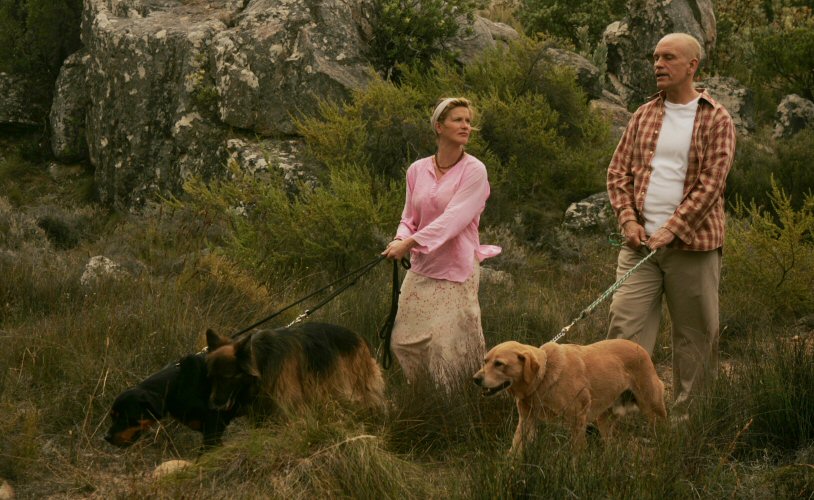
“I’m your ghost,” says Ewen McGregor’s unnamed ghost writer to ex-British Prime Minister Adam Lang (Pierce Brosnan) when they meet on the tarmac at the Edgartown Airport on Martha’s Vineyard. Lang, who has just arrived by private jet and is later described as having "never had a thought in his pretty head,” looks like he’s just emerged from a night’s sleep and a shower. McGregor’s writer – weary, rumpled, fading fast from his own jet-lag, easy to underestimate and actually looking a bit insubstantial – has been dragged along to meet Lang on this appropriately dark and stormy night by Lang’s wife Ruth (Olivia Williams). Lang pauses a beat, doesn’t quite grasp his meaning. Ruth Lang rescues the moment, deftly unsnags Lang’s puzzlement by re-casting the writer’s fairly straightforward self-introduction, at his expense, as a lame attempt at humor – “He’s not usually so humorous” – allowing them all to move on.

Of course it turns out she’s been managing such moments throughout Lang’s whole career in public life, since their mid-70s student days at Cambridge. Now he’s ensconced in his publisher’s beachfront vacation compound, trying to finish an overdue memoir between sorties out on a lecture tour and a just-unfolding crisis of war crimes accusations that brings angry protesters and media frenzy to the compound’s gate. McGregor’s writer steps into this situation to replace the first ghost, a long-time loyal aide who’s washed up on the beach.

More than a few reviewers have noted that Martin Scorcese’s Shutter Island and Roman Polanksi’s The Ghost Writer opened on the same weekend in US commercial release last month, and a couple have admitted they even wished they could say Scorcese’s was the better film. One went so far as to call The Ghost Writer – reluctantly, grudgingly – “even, at moments, wise.” Shutter Island got here right away – reminding me of the younger Scorcese whom I suspected had an evil twin who directed the clunker scenes sandwiched in between the brilliant ones – but Polanksi’s film has just pulled into Carousel's multiplex this past Friday. And perhaps because The Ghost Writer is what Roger Ebert calls “a Well-Made Film,” the notion that it might be “about” something surfaces quietly and later. Beyond being an exceptionally well-executed and stylish political thriller, an obvious what-if speculation on former British PM Tony Blair’s connections with the CIA and the Bush White House torture policies, and quite possibly also a comment on Polanski’s own legal troubles and exile from US soil, The Ghost Writer is a film of ideas. Polanski directs from a script he wrote with Robert Harris that adapts Harris’ own novel – and makes more of “the ghost in the machine” than the ready catch-phrase that term has has lately been reduced to.

Sara Vikomerson used that phrase upon The Ghost Writer's release last month to title her New York Observer review of the film, but she used it there as it’s often used, having seeped into the culture, detached from its source – a ready, somehow familiar phrase, a multi-purpose and archly allusive near-pun that, depending on placement and inflection, evokes sarcasm, dismissal or jaded disbelief. Thus have Toyota’s efforts to account for the Prius’ sudden acceleration problems been dubbed derisively as the car-maker’s search for the “ghost in the machine.” It provides a title for a new book just coming out on the stock market’s unexplained swerves. The phrase appears in films like Brazil and I, Robot, and titles episodes in television series over the past few years as diverse of Inspector Morse, X-Files, Medium, Stargate Atlantis, Ghost Whisperer, and the new Caprica.

If we think of its source much as all, we probably go back only about half-way, to 1981 and the British rock group The Police, whose fourth album was a bleak commentary on modern political and technological culture. The Police’s Sting was an avid reader of the writer Arthur Koestler. In 1967 Koestler used the term to title his 1967 book and explore the idea that modern consciousness and higher brain functions are built atop more primitive, still working parts of the brain, parts that our “higher” selves can’t fully regulate and contain, which accounts for our self-destructive impulses and behavior, and these for rampant violence and paranoia, which Polanski often makes the subject of his films. Koestler himself – and if you pick up the current issue of Harper’s Magazine, there’s a lengthy review of a new biography – took the term from Gilbert Ryle’s 1949 book The Concept of Mind, in which he rejected the persistent and often trouble-provoking Western idea of a mind-body split arising from Rene Descartes’ conviction that only the mind animated the otherwise merely mechanical body.

You absolutely do not need this information to take great pleasure from Polanski’s film. The riveting scene near the end where a note from the ghost writer to Ruth Lang passes from hand to hand across a crowded scene has gotten much attention, but that patiently, precisely built tension is evident throughout and has been much commented upon. There is the mordant Polanski wit; Lang's former foreign secretary tells the ghost writer at one point, "They can't drown two ghost writers - you're not kittens!" There are the excellent performances that Polanski coaxes from even middling actors, from McGregor’s writer turned sleuth, to Brosnan as the wind-up politician that many have sought to animate, to Kim Cattral as his executive assistant, to the cameos – Tim Hutton as Lang’s lawyer, Tom Wilkinson as the shady US academic Paul Emmett, and even a small but striking cameo from a nearly unrecognizable 94-year-old Eli Wallach. Olivia Williams’ Ruth Lang is the most complex portrayal and hopefully we’ll see much more of her.

But “the ghost in the machine” as a set of persisting ideas fills in the brooding form of Polanksi’s film and provides its most resonant and variant images, making it more than a well-made thriller. These range from the stark gray of the rainy weather and the chilly modernist house that itself performs like a machine – during a security check the house locks itself down, metal doors plunging over the floor-to-ceiling windows and sirens blaring – to the BMW’s GPS system whose disembodied voice provides the ghost writer with directions that unlock the story's secret, to the machines that Lang’s very persona and by extension his organization and the networks that envelop him have become.

*******
This appeared in the March 25, 2010 issue of the Syracuse City Eagle.

Monday, February 22, 2010

Film Review #221: Imbued
2009
Director: Rob Nilsson
Cast: Stacy Keach, Liz Sklar, Michelle Anton Allen, Nancy Bower

San Francisco-based indie filmmaker Rob Nilsson has admired actor Stacy Keach since seeing him in John Huston’s classic 1972 film Fat City, where Keach played aging boxer Billy Tully, a washed-up boozer whose brush with a younger boxer (Jeff Bridges) prompts an ill-fated attempt at come-back in both the ring and the bedroom. As a story whose plotline is more valued for its enduring resonance than originality, the latest variation takes aim of this year’s Oscars – as it happens, with Jeff Bridges now in the senior role, this time engaging his demons on a slightly different stage with guitar and mic instead of gloves – as Crazy Heart. In another neat bit of irony, Keach – who remains one of our best actors – is about to start work on a forthcoming TV series, playing a boxer’s father.

The gambler and the showgirl-prostitute, plying their respective trades out on the wild edges of America’s unfinished frontier, is another familiar fable (though Imbued wears that cloak lightly and with some ambivalence – there’s one bit with the national anthem that steers us away from over-reliance on symbolism.) This time, Nilsson sets the action in today, from sunset to sunrise on the 32nd floor of a sleek and soaring but pointedly unfinished skyscraper, San Francisco’s Infinity Tower. We should not be too fooled by the modernity of this glass-walled apartment where a man and woman camp for the night – it’s still littered with step-ladders, paint trays, outsized unframed canvases on stretchers, a broken desk chair and a mattress on the floor, all of which Nilsson makes us notice right away. For all the distant sparkling lights of the city’s skyline, the balcony overlooks an exit ramp off a deserted stretch of freeway. Though wired to the ether of the outside world via cell phones and laptop – and via something more primitive too, in the form of a good-luck Mama Effa statue – Donatello and Lydia surely occupy as remote and isolated an outpost as any in American cinema.

For Imbued – there’s a dictionary definition of the word not long into the movie – Nilsson casts Stacy Keach as Donatello, a football bookie with a fear of heights, his own addiction to the ponies and his own set of ethics for “coming out clean.” Liz Sklar is Lydia, a high-end call-girl who apparently arrives at the wrong door. She’s looking for Brent – Donatello’s just had him on the phone but still playing close to the vest, doesn’t help her out with that – and she has a “problem,” a matter of $2500 she needs to repay by morning.

Donatello doesn’t want sex. “I’ve had sex,” he says. “What have you got that I haven’t had?” But he’s just won a bundle on a Cincinnati race and so offers her the money. We see later that such generosity on his part is usually his standard prelude to skipping out. And Lydia takes it, but not before a protracted kind of strip poker occurs between them, each seeking and offering something other than these encounters usually bring. And not before we see the failures that each can’t shake – Donatello’s fourth, much younger wife (Michelle Anton Allen), his quite lost daughter Tammy (Nancy Bower) and Lydia’s Greg. Donatello’s obsessive fear of heights keeps him from the horizon’s bigger picture – something Lydia introduces him to in a moment of wonderment the like of which I’ve rarely seen pulled off on any screen. These are brave performances – edgy, completely unsentimental and deeply affecting.

But don’t mistake Imbued for one of those emotively intense but formless psychodramas wandering the world. What Nilsson does here with his co-writer Denny Dey, frequent DP Mickey Freeman and cast regulars from previous Citizen Cinema productions – six besides Keach and Sklar, entering the story via phone conversations – is something else. After making primarily cast-workshopped movies for years that he shaped in post-production – early on, this Cassavetes fan found “excessive story” a barrier – Nilsson returns to a script this time. It’s more highly structured than you think, with the phone calls offering pacing and history that counter-weight its present-moment time frame and closed setting. For example, shortly after Lydia arrives she’s on the phone with the insistent madam who set up her date, while Donatello’s on another phone with a Mrs. Baker, an elderly novice bettor of whom he doesn’t wish to take advantage. You find you can attend to both at once, your own capacity for attention enlarged.

Nilsson visited Syracuse last spring as the guest of the Syracuse International Film Festival, which screened four of his films and had him on a couple panels. He’s had a busy eight months since then, with a trip to Trotsky’s birthplace in Eastern Europe for a film project, a first invitation-only screening in January of a new feature titled Sand, and the shopping of other projects. Last month Nilsson enjoyed recognition in New York City with a major retrospective at Anthology Film Archives of the 1970’s San Francisco film collective Cine Manifest, of which he was a founding member.

SYRFILM brings Nilsson back this week, along with Michelle Anton Allen, who's appeared in several of his films and is now producing for Citizen Cinema. There’s a visit to a class at LeMoyne College on Friday morning and then Friday evening Nilsson introduces the East Coast premiere of Imbued at the Palace Theatre. Nilsson also brings a taped interview with Sklar and Keach, and Stacy Keach – who also did the film's spare, surgically targeted jazz score – joins the event live by Skype onscreen for Q&A along with the filmmaker.

******* Nilsson’s “Imbued” screens at the Palace, 2384 James St. on Friday, Feb. 26th at 7:30 PM. Read more about the Cine Manifest retrospective at Anthology Fil Archives by scrolling down here or going to www.thefanzine.com.

Friday, January 29, 2010

Rob Nilsson and Cine Manifest
Anthology Film Archives retrospective highlights still-working filmmaker

Re-posted from www.thefanzine.com, 1/22/2010

In releasing the DVD of his Winter Oranges in 2000, a film set on Sagi Island just off the coast of Hiroshima and concerning encounters between the islanders and a group of tourists, filmmaker Rob Nilsson wrote on the liner, “Only when art is non-political can it be radical. Only when it transcends all political systems and stands for the human heart, the rights of the individual, the reality of human contradiction…and that highly charged, chaotic, largely misunderstood mystery we choose to call love, can it fulfill its cathartic responsibility.”

This might seem an odd introduction to the early work of indie filmmaker Rob Nilsson, three of whose films are part of a Cine Manifest retrospective this month at Anthology Film Archives. Nilsson was an original member of Cine Manifest, San Francisco’s 1970s Marxist film collective. He is still making films at quite a brisk pace, working collaboratively and wrestling with the place of politics in art. Winter Oranges came about from an invitation to Nilsson from Sagi Poiesis II, a filmmaking workshop that brought him together with young Japanese actors and artists to create a film by what Nilsson calls “direct action cinema.”

“Direct action” owes as much to John Cassavetes’ cast improvisations, the 60s-era hire-wire jazz of Sonny Rollins and Coltrane, the production mobility and expanded editing made possible by digital filmmaking and to cinema vérité as it does to Marx. And it owes directors like Bergman, to whom reviewers compared Nilsson’s first feature visually for its bleak winter landscapes. More important for Nilsson, Bergman imposed upon himself the discipline of filmmakers from unfree societies who, constrained from portraying politics openly, have made compelling and perhaps their most deeply subversive stories about human beings. As early as Signal 7 (begun in 1983), despite subplots about a union vote and a union-themed stage play, Nilsson was articulating his aversion to “excessive plot” and his desire for “film [that] could be made from the inside instead of external story hovering over it.”

Winter Oranges is also clearly a direct descendant of Cine Manifest, a group comprising Eugene Corr, Peter Gessner, John Hanson, Judy Irola, Stephen Lighthill, Nilsson, and Steve Wax – and most enduringly for Nilsson, composer/filmmaker David Schickele, who didn’t actually join the collective but worked on many of their films. Except for Gessner, who left the group before its dissolution and became a private investigator, all the original members still work in some aspect of cinema – in film studies, PBS and network television, as filmmakers on both coasts and in the Wisconsin heartland.

II.

The Anthology Film Archives (AFA) retrospective of Cine Manifest runs January 21 through the 28th. Of the nine films included – each screens twice – the centerpiece screenings are the collective’s own two major features (Over-Under, Sideways-Down, 1977, and Northern Lights, which won the Camera d’Or at Cannes in 1979 for best first feature) and a sampling of their shorter documentary work (Western Coal, 1973, and Prairie Trilogy, 1978-80). The AFA program brackets these selections with five more films that elaborate how the collective came to be and shed light on how they functioned and the subsequent directions some of them took.

Jerry Stoll’s 1967 film Sons and Daughters (which Lighthill worked on) documents the Bay area’s anti-Vietnam War movement and influenced the collective’s formation. Irola, who now heads cinematography at the University of Southern California School of Cinematic Arts, developed her 2006 “true story” documentary, Cine Manifest, from a reunion held in 2002 for the purpose of reflecting on the personal and professional consequences of the collective and, the following year, the 25th anniversary celebration of Northern Lights. (The screening schedule is mum on whether AFA will also show the four Cine Manifest “birthday movie” shorts included as extras on the DVD of Irola’s film, but it looks like there would be time.) There are also three post-Cine Manifest films: Nilsson’s tale of two aspiring actors moonlighting as cabbies, Signal 7 (1986), Hanson’s portrait of a woman mine-worker’s conflicts between job and relationship in Minnesota’s Mesabi Range strip-mines, Wildrose (1985), and the Oscar-nominated film Corr partnered on about the McCarthy-era blacklist, Waldo Salt: A Screenwriter’s Journey (1990).

Cine Manifest’s original nucleus came together around the formation of an independent trade union. They wanted to live and make films collectively; their pooled and distributed salaries from other jobs – Lighthill worked for CBS and provided about half – supported about a dozen people and allowed them to do their own projects. Their subjects were those left out of mainstream narratives – for example, farmers, factory workers, women – and they understood all cinema as occurring in some political context. But, although they did immerse themselves in Chinese commune-style self-criticism that eventually led to ruptures, they were not to occupy themselves as filmmakers with simple agit prop. As Hanson later recalled, “We spent the entire time trying to figure out what ‘political’ meant.” To Steve Wax, it meant, “Our films should have a message – and an audience too. People inspire people. Facts don’t.”

As part of a “self-history” of the collective in the media journal Jump Cut (1974, no. 3), Corr and Gessner wrote that attempts like Godard’s were “elitist,” adding, “We won’t concede popular films to Hollywood.”

Speaking in Irola’s 2006 documentary, Nilsson said, “We were pretentious as hell. I read things I wrote and I blanch, but I forgive us because we were all really trying.”

Besides hiring local actors, the collective conducted open casting calls and actors’ workshops for non-professionals, a practice Nilsson kept and has developed extensively since then. The casting for the collective’s first completed feature, Over-Under, Sideways-Down, turned up Johnny Tidwell, who had never acted or gotten beyond the ninth grade. Tidwell – and that film’s male lead, Robert Viharo – continued to work with Nilsson right up to and through the 9@Night films (though Tidwell died before the cycle was completed). Gene Corr told Irola, “We found middle-class people had developed a persona they wanted to protect. Working class people were willing to gamble it all.”

III.

Northern Lights. Begun in 1975 with a two-week shoot in North Dakota, this feature took three years of additional interior shooting and editing back in California to finish and went on to win at Cannes for best first feature. A North Dakota native, John Hanson had originally invited Nilsson to join him in making a 20-minute documentary about the formation of the Nonpartisan League and its victory in the 1916 state elections. Both had roots in the state; Hanson’s father was a farmer and Nilsson’s grandfather had been state photographer and shot the first movie footage there in 1907 before moving the family west to Marin County above San Francisco.

An outgrowth of Socialist organizing and repulsion at the stranglehold on farmers by the Eastern-owned banks, railroads and grain elevators in a time of mass foreclosures and plunging prices for winter wheat, the Nonpartisan League enrolled some 10,000 farmers to sweep the state Republican primary in the spring and the governorship that fall in the general election. The League remained in power for six years in North Dakota, passing social safety-net legislation friendly to working people, creating state-owned banks and grain elevators, giving women the vote, and organizing in thirteen other states.

Hanson and Nilsson would indeed make a documentary on this topic later, but the Northern Lights project rather quickly became what Nilsson called a “hybrid” instead. With Nilsson and Hanson dividing the writing, directing and producing, Hanson focused on working with Irola, who was cinematographer, and Nilsson worked with the cast, largely North Dakota residents except for the Bay-area leads and Bill Ackeridge, who showed up in a number of their films and has one of the leads in Signal 7. The locale was the tiny real town of Crosby and the story centered on farmer-organizer Ray Sorenson (Robert Behling) and his fiancée Inga (Susan Lynch), as they plan to marry, watch their Norwegian families suffer loss and lose their farms, take part in the League’s efforts and try to sustain a relationship.

To structure the narrative like a set of nested boxes, the filmmakers enlisted 94-year-old Henry Martinson – himself a homesteader who lost his farm and joined the League’s efforts – to “discover” Ray’s diary and some old photos, and decide it would “make a good yarn about a time when we had the powers-that-be on the run.” So Henry pounds on an old upright typewriter and soon Ray’s voice takes over, beginning with a diary entry in the spring of 1915 about his plans to “get an answer out of Inga,” fading to a quietly lyrical scene among a stand of birch trees by a pond in which she agrees to marry him. As Inga had stalled on answering him, Ray starts out with little sympathy for the League – he remarks he never met an organizer with a sense of humor – whose local agents are trying to recruit him as the story unfolds. Through a series of diary entries that fade to flash-backs, hard times and wrenching losses – Ray finds his deeply depressed father in a field, frozen to death and still holding his bottle, sees his mother return to Ohio and Inga’s family turned off their land by a plump banker in a fur coat, suffers a break with his brother John (Joe Spano) – convince Ray. He goes on the road for the League to convince equally skeptical others. There’s a text scroll at the end that sums up the League’s history, and Martinson returns, treating us to a tune on his cello, some calisthenics and ruminations about history eventually vindicating the League’s efforts.

“One of these days, they’ll go too far,” predicts Henry of the powers-that-be. “And – well, you know what I’m talking about. I’m an optimist. I can wait.”

Repeated watching doesn’t dim what Cannes judges cited as Irola’s “dazzling” cinematography – fluid, spare yet elegant, keenly and gracefully attuned to the depth with which movement endows image, evocative of the bigness of the land and sky that homesteaders labored within, and to the sheer physicality of their lives. Sometimes shot from barely above ground level – though this magnifies the horizon, Ray’s Uncle Thor also has an oft-repeated joke about hearing the grass grow – and shot through with light piercing vast darkness, here is a film about reaching for and illuminating particular lives long past in a shared place. Just as Henry tramps through woods and drives across the land, so do Ray and Inga. Nilsson was already forty when he made this film, and there’s remarkably little naïve romanticism or arrogance about the power of theory here. When it comes to organizing, Ray doesn’t want to; he and Inga grapple with her real and persistent fears that these efforts and separations will come to nothing and leave them both with no less lonely a life than she watched her mother endure. The power in Ray’s organizing really is rooted in relationship, in group conversations that one senses had to convince this cast as well as the audience – and the occasional “wrassling” match as a means of persuasion.

The AFA retrospective offers Northern Lights in a newly restored 35 mm print.

Prairie Trilogy. This retrospective provides a chance to see films that are now quite rare. Over-Under, Sideways-Down, which examines the travails of a worker who yearns for a break in baseball to escape a water-heater factory with racial tensions, still plays fresh and strong; you come away hoping it could find its way to a DVD incarnation. Likewise, it seems that Waldo Salt should rightfully join the cluster of more recent film projects about artists like Dalton Trumbo and Gertrude Berg who suffered under the blacklists.

But the most striking resurrection may be that of Prairie Trilogy, the three linked short docs of which Hanson and Nilsson make Henry Martinson the star. Prairie Fire (1978, 30 minutes) is Martinson’s telling of the history of the Nonpartisan League, and includes archival footage by Nilsson’s grandfather, Frithjof Holmboe. Martinson recalls his own homesteading some miles outside Crosby, North Dakota – he’d left Sacred Heart, Minnesota, staked by his dad with $65 – and there’s an expanded narration about the national context in those years leading up to World War I and beyond, including the increasingly checkered career of League co-founder A. C. Townley, the recall campaigns of 1921, the sometimes violent harassment of League members, and the smears against them in The Red Flame (a publication that certainly anticipated the Red Channels bulletins of the McCarthy years that poisoned the broadcasting industry).

Rebel Earth and Survivor (both 1980, 60 minutes and 30 minutes respectively) progressively narrow the focus. Rebel Earth follows Martinson on a trek across the state, accompanied by young farmer Jon Ness (Ness and both his parents have small parts in Northern Lights). He searches for his old homestead, also finding an elderly couple who homesteaded near him. He visits the 92-year-old publisher of the Daily News in Minot, Hal Davies, and they recall the years Martinson ran the Socialist paper in town, The Iconoclast. He recalls his later-in-life marriage to a musician who “took a dim view of my organizing.” Ness takes Martinson home to his parents where a gathering of neighbors make music and Martinson reads his poems.

Survivor is a closer-up portrait of Martinson’s history, from his work on a threshing crew that one farmer didn’t want to let sleep in his barn during a blizzard, to his years in the capital with the Departments of Labor and Agriculture, to more poetry (until he died in 1981, Martinson was state poet laureate), to his job as the AFL-CIO’s state recording secretary (the oldest working labor official in the country).

In 1987 Nilsson and Hanson issued all three docs as Prairie Trilogy on a single VHS that’s long out of print. It’s not surprising to discover that Trilogy shares footage with Northern Lights, or that it illuminates the sources of some of the feature film’s plotting and incidents. There’s an historic introduction of the League’s candidate for governor, Lynn Frasier, and Martinson gives a speech in the empty state legislature’s chamber, to the delight of the film crew – these surely inform the scene in which Ray Sorenson practices his introduction of Frasier in the empty church. But, if possible, Prairie Trilogy contains an abundance of footage even more beautiful than that in Northern Lights, a tip-off that the Trilogy is not simply left-over scraps patched together but an intentional portrait that fills a gap in conventional history.

Martinson was a highly quotable, personally accomplished eye-witness, a sort of Renaissance man of his time – and we should wonder if we’re surprised to find him in the middle of the prairie. In Rebel Earth, he and Ness stop at some bars along the way, where young Ness gets in arguments – which you come to see Martinson slyly instigates. And at another point he patiently explains, reinforcing a position not unlike that Cine Manifest had come to regarding their work, “Most of the organizers had songs. It’s not enough to approach people through intellect alone. There must be something that appeals to the emotions.”

The making of Northern Lights was itself an act of rebellion, initiated in a year of critical shifts and battles within Cine Manifest. When Hanson and Nilsson already had their crew in North Dakota, colleagues back in San Francisco tried to veto the project. David Schickele, who did edit the film, thought it was a bad idea too. Nilsson and Hanson simply went ahead anyway, forming New Front Films along with attorney John Stout (who remains active in Nilsson’s ventures to this day) to manage the production. Secondly, that summer Judy Irola had gone to Copenhagen to work on a feminist film. Afterward she kept working with Cine Manifest, and overall gave the collective good marks from her new horizons, but wanted to shoot films herself. And disputes within the collective about the making of Over-Under, Sideways-Down – actually finished in advance of Northern Lights – led to the group firing Peter Gessner from both the film and the collective. Cine Manifest continued until 1978 or ’79 – depending on accounts – with some additions, and certainly with a constellation of people who repeatedly worked together over the years.

IV.

Signal 7. Nilsson made a trio of films in the mid-80s, projects he picked up, set down, alternated raising funds for and editing, as he is wont to do – very often his films come out some time after the initial shoot, and not always in order of production. These three were all released on DVD in 2005 by Koch Lorber: Signal 7 (the cabbie tale, dedicated to John Cassavetes and drawn from his own Boston cabbie days), Heat and Light (which drew on his African years, first in the Peace Corps in Nigeria and later in Biafra, and addressed the narcissism of the lead character, a obsessively jealous photojournalist whom Nilsson played himself), and the cross-country running cult classic with Bruce Dern, On the Edge.

Signal 7 seems an astute choice as an example of Nilsson’s early post-Cine Manifest work, a demonstration of both his roots and the directions in which he would go. From early on, Nilsson has said he regarded Cassavetes’ work as “not an anomaly, but a way.” Cassavetes had already made Shadows (1959) and Faces (1968) when Cine Manifest formed; during the 70s he also made such films as A Woman Under the influence (1974), The Killing of a Chinese Bookie (1976) and the bravura performance film Opening Night (1977). What Nilsson is now calling “direct action” has roots in both which has he refined and expanded over the years, making extensive use of cast rehearsal and work-shopping of characters’ back-stories, but not of the scenes to be filmed. (He says he “lost” a scene once, from Heat and Sunlight, that never measured up in the actual filming to its workshop improv “and I decided that was an omen"). Though he has sometimes worked from a script, the direct action films develop their dialogue and storyline in collaboration with the cast from an outline he, and often a co-writer, provide.

Last spring Nilsson told me in an interview, “I’m trying to get away from theater. With the exception of certain avant-garde styles, theatre is a way of coming up with something to do and then rehearsing it and rehearsing it until it’s entirely a re-creation. I’m trying to have the whole thing be creation. To me that’s what cinema does so much better. You can be right there in the moment. It’s the one time that interests me, the one time that this particular phrase is spoken. And is that it? No. Now I take it into what I call the alchemical lab and I start to edit.”

Beginning in near dark and jazz-fueled, Signal 7 concerns two aging cabbies, Marty and Speed (Dan Leegant and Bill Ackeridge, both Nilsson regulars), over a single night shift at DeSoto Cabs in San Francisco. There is a subtext of labor issues, to be sure – city cabbies have just rejected a bid to unionize, and both men break for late night auditions for Odets’ labor drama Waiting for Lefty. But the weight falls on their own relationship and how each provides the other with a listening ear for secret aspirations – their long-planned trip to L.A. to take up acting seriously – as well as ready-made reasons not to go in the form of other obligations. During the night a cabbie is murdered (“signal 7” is the cabbie distress call), both join their colleagues for cards and bawdy jokes, Speed picks up an Israeli woman whom he scares with his attempt to impress her and he gets a rather pretentious acting exercise that proves as harrowing to watch as it is for him. Really an inventory of the ways men try to get right the roles they think they should play, Signal 7 comes to rest in an unexpected scene of wholly unsentimental tenderness between Speed and his wife. A number of Nilsson films end at dawn with similar exhausted intimacy, a caution this may be all we have when the masks come off.

V.

In the decades since Cine Manifest, Nilsson has continued to work collaboratively. Besides workshop projects in Japan (which resulted in Winter Oranges), Jordan (Samt/Silence, 2004) and South Africa (Frank Dead Souls, 2008), he’s gone to Kansas City (Opening, 2006). In 1989 he travelled with musicians John Cale and Brian Eno to Amsterdam, Russia and Wales around the recording of The Falklands Suite, resulting in the documentary, Words for the Dying (1990). In 1991 he set up shop in San Francisco’s red-light district for the 14-year-long Tenderloin Action Group/Tenderloin yGroup, on-going workshops that produced first the billiards classic Chalk (1996) and then 9@Night (2002-07), a nine-film cycle with overlapping time frames, key scenes that recur across films, and some fifty characters that first screened in its entirety at Harvard Film Archives in the fall of 2007. His collaboration with the San Francisco Digital Film School resulted in Security (2005) and in 2007 the haunting Presque Isle (2007), set in his paper mill hometown of Rhinelander, Wisconsin. At his own outfit in Berkeley, Citizen Cinema, Nilsson continues to offer workshops and apprentice new filmmakers. Last spring he completed Imbued with Stacey Keach. In the past year, he’s been shopping a film idea about the abstract expressionist painter Willem de Kooning, shot footage during a pilgrimage to Trotsky’s birthplace (and, over Christmas, supplemented that with footage of the prairie outside Kansas City, the “American steppes”). Earlier this month another feature, Sand, had a first by-invitation screening in San Francisco.

From Northern Lights on, all of Nilsson’s films have had their official premiers at the Mill Valley Film Festival north of San Francisco (though Northern Lights had a first screening in Crosby, North Dakota), and he makes the festival circuit as well. Last spring he came to Syracuse, where I live, for a tribute mini-retrospective during the Syracuse International Film Festival. On that trip he left a screener here of Imbued, and next month he’ll return to Syracuse for the East Coast premiere on February 26th.

Imbued has screened at a number of other festivals since its premiere last fall at Mill Valley, and the prospect of its reaching a larger audience in the wake of AFA’s retrospective is exciting. Imbued had a script to work from and a smaller cast than usual in a Nilsson film. An aging football bookie with a fear of heights, whose fourth young, needy wife believes he’s an actuary, Donatello (Stacy Keach) sets up shop for a weekend in the upper reaches of an unfinished high-rise (Imbued was filmed in the Infinity Building, San Francisco), supplied with a couple cell phones, a quart of whiskey, his laptop, and the dictionary he’s systematically memorizing to fend off panic attacks. Arriving at the wrong address, a call-girl named Lydia (Liz Sklar) winds up staying the night. Donatello’s wife Sylvia calls (Michelle Anton Allen, from the 9@Night film, Go Together, and Presque Isle), as does his estranged crack addict daughter, Tammy (Nancy Bower), each seeking some connection with him. Both Donatello and Lydia imagine they understand the politics of gender and each is rudely albeit unmaliciously awakened, again by dawn.

Since the recent Westerns There Will Be Blood, the remake of 3:10 to Yuma and Appaloosa, and even David Milch's Deadwood, all employed sets of framed-in, unfinished construction for pivotal scenes in such a way as to comment on American life, as the Western seems such a ready template to do – in those cases, that we are still living in that young, unfinished house – it’s hard not to hear an echo of that in this film with its gambler and saloon girl, despite the sleekness of the skyscraper.

Nilsson might demur. “Politics,” he told me, “is about choosing sides. But I can’t choose any sides, because I represent everybody in a particular context. Artists try to say, ‘Look, it’s okay. See, this is how we are. And this is the pain and this is the joy. This is the eighty years you get. You know, take a look. Take a look.’”

*******
This article appeared on 1/22/2010 in www.thefanzine.com, editor Casey McKinney.
Judy Irola’s "Cine Manifest" doc is also available at Netflix, as are Nilsson’s "Signal 7," "Heat and Light," "On the Edge," and a recent reissue of "Words for the Dying." Irola has a new film due out this fall entitled "Niger ’66: A Peace Corps Diary." "Northern Lights" is available again on DVD from Nilsson’s Citizen Cinema in Berkeley, California, as are the "9 @ Night" films and others. "Prairie Trilogy" is not yet available on DVD, and I thank the filmmaker for lending me his VHS copy.

Sunday, January 17, 2010

Film Review #220: Sound Tracks: Music Without Borders
2010
Stephen Talbot & David Davis for PBS
Cast: Marco Werman, Alexis Bloom, Arun Rath, Mirissa Neff

“Russians love tragic songs,” says former rock’n’roll dissident Alexander Yelin, creator of “A Man Like Putin,” the 2002 runaway hit music video that Vladimir Putin liked enough to use in his 2004 presidential run and still uses at rallies now. “At its core, this is about female tragedy. A woman lives in the provinces. She’s surrounded by dirt and drunkards. She wants the guy she sees on TV.”

Clad in his Pearl Jam tee-shirt and busy promoting an all-female heavy metal band now, Yelin tells reporter Alexis Bloom he has no regrets about writing the song – on a $300 bet – that has contributed to strong-man Putin’s cult of personality as Russia’s ideal man.

“I’m a professional,” he says. “I can write whatever you want. I could write an anti-Putin song, but right now there’s no market for it.”

Bloom grew up in apartheid South Africa and her resume includes an undercover investigative report about life under Zimbabwe dictator Robert Mugabe, so she may know a thing or two about media and politics. Her 18-minute story on the career of one supposedly innocent feel-good pop song is unexpectedly bracing and leads the pilot for a new PBS show.

Unusually well-made and combining astute cultural and political analysis with some terrific world music, the arrival next week of PBS’ music magazine Sound Tracks: Music Without Borders is good news indeed. Even better, WCNY Channel 24 will carry the program, whose pilot airs both here in Central New York and nationally next Monday evening at 10 o’clock.

Sound Tracks is a West Coast entity, the offspring of veteran documentary filmmaker and PBS FRONTLINE/World’s Stephen Talbot, long based in San Francisco, and Oregon Public Broadcasting’s multiple Emmy-winner David Davis. Besides Bloom, Talbot has recruited FRONTLINE/World reporters Marco Werman (who serves as host) and Arun Rath, as well as deejay/San Francisco Bay Guardian art director/journalist Mirissa Neff, for a three-feature format with a performance closer called “Global Hit.” The editing, semi-animated graphic design that bridges segments, music themes and sound design are all crisp, graceful and bright. But beyond that, Sound Tracks asks in each of its segments questions about music's purpose - and art's - that go well beyond the insular assumption of mere entertainment. How delightful that Sounds Tracks also manages to provide such first-rate entertainment. Sound Tracks also enjoys the input and participation of the Center for Asian American Media, Latino Public Broadcasters, National Black Programming Consortium, Native American Public Telecommunications, and Pacific Islanders in Communications.

After Bloom, Marco Werman goes to Lagos, Nigeria, to explore music’s purpose with the youngest son of legendary Fela Anikulapo Kuti. The current Broadway musical Fela! recounts how Kuti – inspired by the Black Panthers and Malcolm X – combined 1970s U.S. jazz and funk with West Africa juju to create what he called Afrobeat, railing against the military regime’s brutality and theft of oil profits in a mix of Pidgin English and Yoruba. Fela died in 1997 of AIDS; he had been arrested over 200 times and – after the release of his ’77 album Zombie – his home torched and his elderly mother thrown out an upper-story window. Seun Kuti was just 14 when his father died, but took over Fela’s band, the Egypt 80, and continues to carry on as cultural provocateur.

In the third segment, after landing by balloon in the Kazakh capital’s central marketplace and reminding us this culture dates back to Genghis Khan, reporter Arun Rath joins violinist Marat Bisengaliev – “Kazakhstan’s Itzhak Perlman” – and travels with him to Hollywood. Sasha Baron Cohen’s 2006 film Borat, actually filmed in Romania, offended Kazakhs in multiple ways. Bisengaliev focused on the fake national anthem – one line proudly hails the “cleanest prostitutes in the region” – written by the filmmaker’s brother, Erran. Bisengaliev invited the composer to write a symphony for Kazakhs as a way of making amends; Sound Tracks filmed its premiere performance and the Kazakh audience’s response.

The short closing segment centers on the mournful traditional Portuguese bar songs called fado – meaning fate or destiny – usually sung by women in black, accompanied by drums and classical guitar. The diva Mariza, European sensation and star of Carlos Saura’s film Fados – sings “Minh’ Alma/My Soul” at a massive outdoor Lisbon concert.

Publicity for Sound Tracks promises it’s good for a whole season and that subsequent shows will take us to bayou Louisiana, Havana, Paris, the desert music festivals of Mali, bluegrass country and Bollywood. But there’s no word on a regular time slot, so my guess is that audience feed-back will count for a lot in whether we see more installments.

*******
This article appears in the 1/21/2010 print edition of the Syracuse City Eagle weekly. “Sound Tracks” debuts Monday, 1/25 at 10:00 PM PBS stations nationally, including here in CNY on WCNY Channel 24. See a trailer from “Sound Tracks” and read this article online, along with others arts and entertainment coverage from Eagle Newspapers, at cnylink.com – click A&E.

Thursday, January 07, 2010

Film Review #219: Séraphine
2008
Director: Martin Provost
Cast: Yolande Moreau, Ulrich Tukur, Anne Bennent

During the Renaissance, artists commonly took the name of their home village or city – for example, Leonardo da Vinci. Wilhelm Uhde, the German art critic who discovered Séraphine Louis in the French village of Senlis shortly before the outbreak of World War I, adopted this practice to distinguish the creator of ecstatic paintings of nature in the style he called “modern primitive.” As we see in French director Martin Provost’s 2008 film of the same name, the reticent, sometimes socially abrasive Séraphine (Yolande Moreau) at first believed that Uhde (Ulrich Tukur) was mocking her when he compared her work – rendered in home-made finger paints of stolen church candle wax, blood from the butcher shop, pond scum and other “secret ingredients” – to those of the old masters. In fact, when not traipsing through the countryside in her own version of pre-Avatar rapture, Séraphine is most often seen on her knees – scrubbing, painting in her locked room, or praying. The film’s other pervasive image is that of a door or window opening into startling light beyond the dark, cramped interiors of Senlis homes and shops – fitting for a portrait of this early “outsider” artist who found only meager sustenance from most social relations, and also suggestive of her access to transported spiritual states.

Provost’s dramatization of the relationship between the two – ruptured by war, madness and Uhde’s own vicissitudes of loyalty – won seven César Awards in France (including Best Actress for Yolande Moreau’s luminous performance in the title role) and in December was named Best Foreign Film By or About Women by the national Women Film Critics Circle here. Last Sunday, at their awards meeting in a Manhattan restaurant, the National Society of Film Critics also designated Yolande Moreau Best Actress in a 2009 film. (A friend and sometime collaborator of countrywoman Agnes Varda, the Belgian Moreau can also be seen in Varda’s currently running, much acclaimed The Beaches of Agnes – she also had a part in Varda’s 1985 film Vagabond – and her own The Sea Also Rises from 2004 is available at Netflix).

Séraphine premiered in Paris in October of 2008 and in New York last March at Lincoln Center’s annual Rendez-Vous with French Cinema festival. There was a DVD release in Canada last June, but the theatrical run in the States of this quiet, distinctly non-blockbuster film has been quite limited, so its appearance in Central New York at all makes it worth a short drive to Hamilton, where it’s currently got a five-day run.

Uhde had already been the first to buy work by Picasso and Braque and to write about Henri Rousseau when he sojourned in Senlis and there stumbled upon a painting of apples by the eccentric middle-aged woman who scrubbed his floors. Séraphine Louis, orphaned early, impoverished and fragile, began painting because her guardian angel commanded her to do so – she had spent twenty years working in the local convent – and she died in 1942 after spending the last decade of her life in the Clermont insane asylum. She met Uhde in 1912, during the period she kept a dingy room in town and picked up odd jobs at cleaning and laundry. The film compresses this first period of their acquaintance to just 1914, ending when Uhde – a Jew and a gay man – hastily left France with his sister Anne-Marie (Anne Bennent) as German troops advanced. Because he was German, the French government had already confiscated and sold off his art collection.

It was Séraphine, entering his ransacked rooms, who saved Uhde’s notebook and returned it to him in 1927, when he was again living in France at nearby Chantilly, and they resumed their association. Uhde then supported her with a small stipend and in 1929 organized an exhibition entitled “Painters of the Sacred Heart” that featured her work. Séraphine had extreme difficulty integrating such material support and recognition, and she became increasingly unstable. Uhde meant for her to be able to buy paint and canvas and stop scrubbing floors. She rented the entire upper floor of her building, decorated lavishly, tried to purchase a villa – Uhde put his foot down at this – and, inscrutably, ordered a bridal trousseau. When she went door to door in the white lace dress and veil, the neighbors had her locked up.

In the film, Uhde visits her just twice at the asylum. She does not respond to him the first time and – in a resonant reversal of image – he only observes her through a window the second. But he does pay for a private room at the asylum that allows her privacy and the freedom to take walks in the fields. The extent to which Uhde abandoned or exploited Séraphine personally or was a product of his times – in the film a doctor advises him against trying to see her again, insisting such contact would make her worse – remains enigmatic in Provost’s telling. Uhde also continued to exhibit her work in Paris and elsewhere, and announced her death some years in advance of the fact. But Uhde served Séraphine’s work itself well, which has endured and enjoyed its own renaissance; the exhibition of her paintings at the Musée Maillol in Paris that began in October 2008, coinciding with the film’s opening, ran until mid-September of 2009.

*******
An abbreviated form of this review appears in the 1/7/10 print edition of the Syracuse City Eagle weekly. “Séraphine” is well worth a drive to Hamilton – closer than Ithaca – where it opened Wednesday for a five-day run at Hamilton Theater, 7 Lebanon St., 315.824.2724. Screens daily at 5:30 PM through Sunday, 1/10. Take Route 20 east through Caz and Morrisville, turn south on Route 46 (which becomes 12B). About 40 miles, though winter weather may add time.

Monday, December 28, 2009

Film Review #218: A Christmas Sampler
Thumbnail Reviews of James Cameron’s Avatar, Nancy Meyers’ It’s Complicated, Rob Marshall’s Nine, Guy Ritchie’s Sherlock Holmes, and Jason Reitman’s Up in the Air

It turns out that The Young Victoria, subject of last week’s preview column – it opened Christmas Day at Manlius Art Cinema and would still be a perfect reason to make that short, snowy drive east of the city – is only the tip of the late December movie iceberg. This is a good thing, because overall it’s been a scantier film year than 2008. Awards season cranks up as the year winds down, so some of us have been on targeted missions into the multiplexes – and not for Uncle Joe’s Christmas tie. This week we offer something a little different – not a Top Ten list but a holiday sampler.

First at the box office comes Avatar – in its first ten days it grossed, in the U.S alone, almost half the $430 million spent on its production and marketing – James Cameron’s fable about a crippled U.S. Marine who goes undercover on the planet Pandora, joins with the native Navi people and leads an insurrection to save their sacred lands. Like last year’s WALL-e, Avatar has a message, and Cameron has imbued it with additional Native American myth. Sam Worthington stars as Jake Sully, with Zoe Saldana as Neytiri, the Navi woman who takes him in and teaches him her people’s ways, and Sigourney Weaver as Dr. Grace Augustine. This is a particularly fitting role for Weaver, who brings inevitable echoes of her own Ellen Ripley from the Alien quartet, the second of which Cameron directed in 1986. (Michelle Rodriguez, who plays the helicopter pilot here and whom you may recognize from TV’s Lost, is not the same actress from that film – who can forget Pvt. Vazquez’ “Let’s rock and roll”? – but she looks enough like her to make the casting intentional). Avatar is almost three hours long, tight as a drum, visually breath-taking and moving as all get-out. Make sure to see it in 3-D.

One of three films that opened here Christmas Day, Nancy Meyers’ light comedy It’s Complicated is the latest from national treasure Meryl Streep as Jane Adler, torn between her re-married ex-husband Jake (Alec Baldwin, a very good sport here) and her shy architect Adam (Steve Martin). I confess that possibly only Meryl Streep could lure me into a Steve Martin movie. In this confection, Jane has three young adult kids, a delightful set of women friends (Rita Wilson and Mary Kay Place among them), and a see-all son-in-law-to-be (very well-played by John Krasinski). The cast had as good a time making this large-hearted, very funny movie as you will watching it – especially the lap-top scene.

“Pastiche,” says the British film writer Richard Dyer, is best defined as knowing imitation. I admit I found the prospect of Daniel Day-Lewis in the role created by Marcello Mastroianni for Fellini’s masterpiece 8 ½ intriguing, and the cast of women – Marion Cotillard, Penelope Cruz, Judi Dench, Fergie, Kate Hudson, Nicole Kidman, Sophia Loren – delectable. Nine is Rob Marshall’s film version of the musical based on Fellini’s film, staged in 1982 and then again in 2002. Nine is meant as a tribute to Italian cinema and some of the echoes are there. Loren’s cameo as the mother of 1960s-era director Guido Contini (Day-Lewis), creatively blocked on the eve of a new shoot, is of course close to perfect on several levels. The flash-backs of Guido as a boy running with his pack of buddies along the horizon through the wheat fields wonderfully echo Rossellini’s boys in Rome, Open City – and a number of others. And as Contini’s aggrieved wife, Cotillard delivers the smash performance of the film (with Dench coming in a close second). But Nine is bloated, uneven, and jarring in spots. It’s telling that American actress Kate Hudson’s musical number is what gets the spotlight reprise as the end credits roll, and I hope U.S audiences will not be fooled that this knock-off is the real thing.

Officially Jason Reitman's Up in the Air opened on the 25th too, but we got it here last Wednesday. It is not the best picture of the year by a long shot. But there is something brewing here worth looking at – about the toll that corporate culture has taken on us all in this recession and about the roles of men and women in the financial and social freedom that modern business culture creates for an elite class. Fine performances from George Clooney as Ryan, the ungrounded corporate hatchet man who fires people, Anna Kendrick as the young whippersnapper, and Vera Farmiga as Alex, whose secret twist should not be the jolt it is when it arrives. Alex is an especially troubling figure in her success in achieving all that a man might, complicated by very winning sequences as sympathetic older sounding board when Natalie’s boyfriend dumps her and as Ryan’s date at his younger sister’s wedding. But her turning the tables on Ryan is no victory for women. Up in the Air arrives at a seemingly perfect moment for its subject matter, with its book-end montages of people getting the news they’re fired, its aerial views and its characters' assumptions they know "the big picture," and its sleek industrial look. But adapted from a novel by Walter Kirn written earlier in the decade, its message is still older, so the film easily takes its place among a long line of films and novels deeply wary of modern business life. And the scene in which Ryan arrives onstage at the Mecca of motivational speakers’ conferences in Las Vegas – the symbol of all he is willing to walk away from for Alex – eerily reminded me of what Kevin Costner’s character wound up settling for, a kind of spiritual death after his loss of the Whitney Houston singer – in The Bodyguard. Now that was 1992, and we still didn’t get the message?

English director Guy Ritchie lost Madonna this year and he got yet another bad rap from the movie critics. But even if he is an acquired taste – see Snatch, Revolver, Rocknrolla for starters – Sherlock Holmes is much better than you’re hearing. Gloriously detailed in its look at London’s seamier side (see the January issue of Smithsonian magazine for a tour of Holmes’ London), this film has witty, sharply timed performances from Robert Downey, Jr. as Holmes and Jude Law as Dr. Watson, plus some terrific action staging. It’s a treat, and it lays the groundwork for sequel with the beginnings of a Professor Moriarty yarn.

It’s true that The Princess and the Frog is not on this list – some of my goddaughters and I are tackling that one later in the week.

*******
This review appears in the 12/31/09 print edition of the Syracuse City Eagle. These movies are screening at area multiplexes. “Make it Snappy” is a regular film column that’s also available online, usually with trailers, at www.cnylink.com – click A&E, where you can read other arts coverage from Eagle Newspapers.